
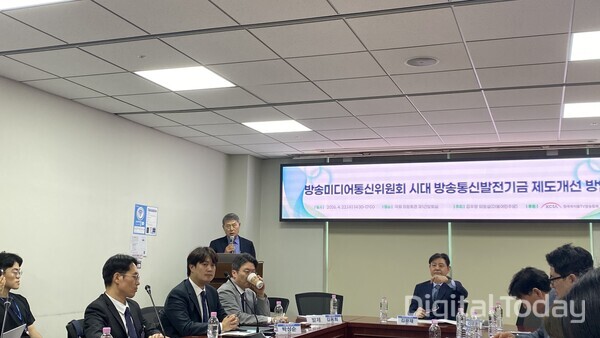
The cable TV industry urged the Broadcast Media Communications Commission (BMC) to keep discussing a plan to cut the Broadcasting and Communications Development Fund levy rate, which is known to have been reviewed by the Ministry of Science and ICT to a near-final level.
The BMC says it will commission research and conduct a comprehensive review of the overall levy system for pay TV, terrestrial broadcasters and programme providers. It is unlikely that a new levy rate can be reflected by the annual levy-rate decision scheduled for August.
Hwang Hee-man (황희만), chairman of the Korea Cable TV Broadcasting Association, said at a forum held on Tuesday at the National Assembly Members' Office Building in Yeouido that he understands the science ministry reviewed to a near-final level a plan to adjust the levy rate for system operators from the current 1.5 percent to 1.3 percent. He said he hopes the accumulated discussions and policy reviews will continue at the BMC without interruption.
He added that other broadcasters already have a reduction system that reflects management difficulties such as losses, and the same principles and standards need to be applied to system operators.
The Broadcasting and Communications Development Fund is a special levy based on Article 25 of the Framework Act on the Development of Broadcasting and Communications. Broadcasters and telecom companies pay a certain percentage of sales. For system operators, the current 1.5 percent rate applies based on broadcasting service sales. The level has been maintained for 8 years since 2017.
The problem is that the speed of deterioration in system operators' profit structure has far outpaced the burden of the fund. Broadcasting business sales of system operators fell 25.3 percent over 10 years, to 1.68 trillion won in 2024 from 2.26 trillion won in 2015, and operating profit plunged 96.3 percent to 14.9 billion won from 405.2 billion won over the same period. The fund payment, by contrast, was 25 billion won, creating a reversal in which the fund amounts to 168 percent of operating profit. Of 90 system operators, 52 companies, or 57.8 percent, are in a net loss position but must still pay the fund in full.
Market structure has also been upended by intensifying competition with OTT services and IPTV. IPTV broadcasting sales jumped 165 percent over the same period to 5.05 trillion won from 1.92 trillion won, widening the sales ratio versus system operators to 3.02 times from 0.85 times.
Experts issued concrete warnings about a structural crisis in the system operator industry. Kim Yong-hee (김용희), a professor of business administration at Sun Moon University who delivered a presentation, said the outcome despite system operators being early entrants ultimately comes down to accumulated regulation. He said if institutional improvements are not made, the industry's survival itself could become impossible in 2029.
Kim also presented 4 adjustment proposals. Option 1 applies a one-third across-the-board reduction to all system operators by applying the public-interest logic used for KBS and EBS, resulting in an effective 0.99 percent rate and a fund of 16.7 billion won. Option 2 applies the relief system used for regional private broadcasters, with an effective 1.0 percent for profitable system operators and 0.5 percent for loss-making operators, resulting in a fund of 11.8 billion won. Option 4 applies a uniform 1.1 percent using a formula that reflects regional channel investment ratios, resulting in a fund of 18.5 billion won.
Kim's recommended proposal is Option 3, a combined plan. It reduces the basic levy rate to two-thirds for all system operators by applying the public-interest logic used for KBS and EBS, while applying an effective 1.0 percent for profitable operators and 0.67 percent for loss-making operators. If applied, the fund would fall to 13.4 billion won from 25 billion won, and the fund-to-operating-profit ratio would drop to 90 percent, resolving the reversal. Kim said the 1.3 percent discussed at the ministry is, in his words, "like peeing on a frozen foot," and said there is no basic room for innovation as long as the fund remains at a level that exceeds operating profit.
Institutional inequity was also raised. Because the reduction clause in Article 13 of the Enforcement Decree of the Framework Act on the Development of Broadcasting and Communications applies only to terrestrial broadcasters, general programming channels and news programme providers, system operators are excluded. As a result, JTBC pays 0 won in a loss position and KBS pays only 0.01 percent, while 38 system operators with operating losses pay 9.5 billion won in full. Kim described this as a "legislative flaw." He also pointed to the fact that system operators have an obligation to run regional channels under Article 70(4) of the Broadcasting Act and invest 115.9 billion won a year out of their own funds.
Industry and experts also commonly point out that adjusting the levy rate is possible without revising the law. The current notice on calculating and imposing the fund contribution, overseen by the science ministry, contains no reduction provision for system operators. A notice for terrestrial and general programming channels (Korea Communications Commission Notice No. 2022-14) includes various reduction mechanisms such as additional relief in the event of losses and a 150 percent cap, but system operators have no equivalent provision. A notice revision can be decided by the competent ministry without a cabinet vote, making the process simpler than a law revision. Kim stressed that immediate implementation is possible through a notice revision alone and a law revision is not necessary.
Choi Jin-eung (최진응), a researcher at the National Assembly Research Service, proposed dividing steps into short-, mid- and long-term measures. He said revising the notice is something that can be done immediately without revising the law, and said if operators keep saying there is a problem but only a long-term plan is offered, that suggests there is no solution or no will to resolve it. He added that when the BMC was launched in October last year, there were discussions at the science ministry about lowering the rate to 1.3 percent, and there was a nuance that a forward-looking approach was needed as duties were transferred, but it should have been made a policy agenda at the working level at that time.
Some view the fiscal gap from lowering the levy rate for system operators as being largely offset by the natural increase in IPTV fund payments. There were also calls to expand the levy base in the long term by collecting from non-paying businesses such as OTT services and portals to secure funding.
Some members of the BMC shared that view. Lee Sang-geun (이상근), a non-standing BMC member who attended, said the pie for legacy media is shrinking while new media that does not pay the fund is growing, adding it is his personal view that alternatives should be sought from OTT services and portals.
Criticism also continued over how the fund is spent. While the fund created for broadcasting media development is spent on operating expenses for Arirang TV and Gugak Broadcasting and on running costs for the Press Arbitration Commission, the share that is directly returned to broadcasters that pay it is only 6.5 percent.
Lee Jong-kwan (이종관), a senior expert adviser at Shin & Kim, highlighted the asymmetry between rights and obligations. He said that if cable TV were to realise regionality without an obligation to run regional channels, the government would have to consider how much it would cost. He said that when alternative costs for regionality are considered, a 150 billion won investment is rather cheap. He added that from the principle that if rights are equitable then obligations should be equitable, and if obligations differ then rights should also differ, cable TV's situation is highly asymmetrical. On restructuring spending, he said it is natural that if the size of collections is shrinking then spending should also shrink, and urged parallel review.
BMC: "We will commission research... August this year will be difficult"
The BMC side said it agrees there is a need to adjust the levy rate, but that immediate improvements such as revising the notice are difficult. It said separate review procedures are needed because duties were transferred from the science ministry in an unfinished state.
Sung Jae-sik (성재식), head of the BMC finance team, said he has not confirmed whether the science ministry conducted research services, and heard that it decided through internal review procedures to lower the rate to 1.3 percent. He said it is regrettable that the burden would have been less if the levy-cut procedure had been completed before the transfer from the science ministry, adding that because it came over in an unfinished state, the BMC has to think again from its standpoint.
On revising the notice, he said the two notices that had been split between the science ministry and the Korea Communications Commission should be integrated as soon as possible and the levy system unified. He also said that even if work begins now to overhaul the levy rate, it is not easy in terms of time because the levy rate is decided in August this year. The BMC plans to commission a research project soon to review the overall levy system for existing pay TV, terrestrial broadcasters and programme providers.
On restructuring fund spending or ways to secure funding, he said efforts have been made for 20 years to move Arirang TV and Gugak Broadcasting to the general account, but it did not happen because of differences with fiscal authorities, adding the BMC cannot do everything at its own discretion. He said it is a difficult issue because they must also think together about how to secure funding that would be insufficient if the rate is lowered. He added that personally, he thinks fund collection from OTT services and portals should also be actively reviewed in the long term.
 Seulgi Son
sageson@d-today.co.kr
Seulgi Son
sageson@d-today.co.kr