
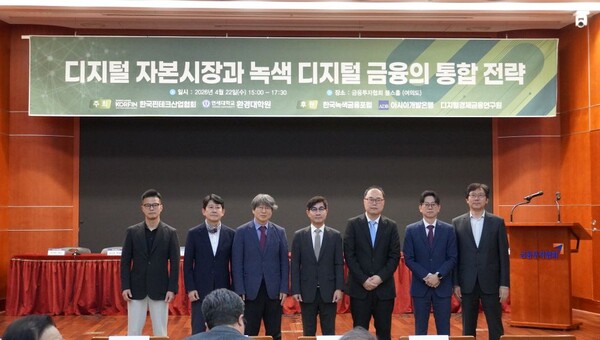
As digital assets spread and accelerate a broader shift across capital markets, a forum was held to discuss an integration strategy with green finance.
The Korea Fintech Industry Association held a seminar titled "Integration Strategy for Digital Capital Markets and Green Digital Finance" on Tuesday at the Financial Investment Association's Bulls Hall in Yeouido, Seoul, jointly with Yonsei University's Graduate School of Environmental Finance. It was sponsored by the Korea Green Finance Forum, the Asian Development Bank and the Digital Economy and Finance Institute.
The seminar was held to address digital capital markets and green finance together from the perspective of financial infrastructure transformation, rather than as separate domains, and to discuss domestic policy tasks and directions for Asian cooperation.
Min Byeong-deok (민병덕), a lawmaker from the Democratic Party of Korea who attended the event, said the spread of digital assets such as token securities and stablecoins is changing the overall structure of capital markets, including issuance, distribution, payments and custody. He emphasised that blockchain-based finance and the digitisation of carbon credits would provide momentum to link markets and expand financial cooperation in Asia.
Lee Kang-il (이강일) said blockchain and distributed ledger technology strengthen trust in financial infrastructure based on data transparency and immutability. He said green digital finance, including the tokenisation of carbon credits, can expand links between markets.
Kim Jong-hyun (김종현), chairman of the association, said the spread of digital assets is accelerating structural changes in financial infrastructure. He said the group would continue communicating with policymakers based on views from the industry.
In Session 1, Jeong Yoo-shin (정유신), head of the Digital Economy and Finance Institute, presented on "Institutions and Market Structure of Token Securities (STO)," and Seo Byeong-yoon (서병윤), chief executive of DSRV, spoke on "Stablecoins and Payment Infrastructure."
Jeong said token securities combine the legal structure of traditional securities with blockchain technology. He said institutionalisation in South Korea could be a starting point for the shift to digital capital markets. He added that while existing capital markets separate issuance, distribution and settlement, token securities, based on distributed ledgers, integrate the transfer of rights and settlement.
Seo said existing overseas remittances are inefficient in terms of settlement time and fees. He said stablecoins are an alternative that can reduce payment time and costs.
In Session 2, Hyun Seok (현석), a professor at Yonsei University's Graduate School of Environmental Finance, and Heo Gyu-man (허규만), a doctor at the Asian Development Bank, presented on green finance and carbon markets, respectively.
Hyun said capital moves quickly but market structures remain fragmented by function such as issuance, trading and settlement. He said the core of digital finance is not simply integrating them, but designing connection structures based on interoperability.
Heo said Asian carbon markets are fragmented in terms of institutions, data and infrastructure. He said digital assets and blockchain can be a means to complement this. He added that the digital transition of carbon markets is an issue of building trustworthy trading and settlement infrastructure.
In the panel discussion, Yoo Gwang-yeol (유광열), head of the Korea Green Finance Forum, served as chair. Presenters and officials from industry and research institutions took part to discuss ways to link digital capital markets and green finance.
 Ji-young Lee
ljy@d-today.co.kr
Ji-young Lee
ljy@d-today.co.kr