
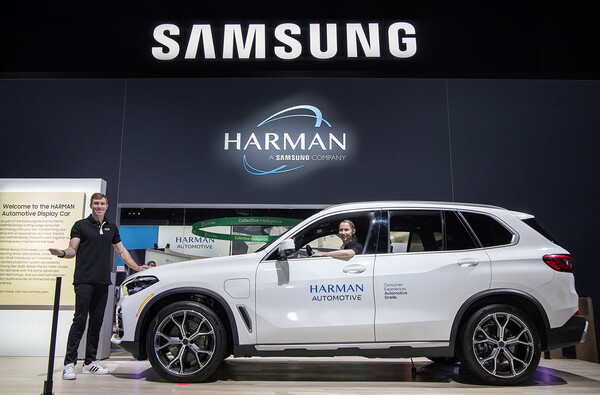
Samsung Electronics' subsidiary Harman has risen from an audio powerhouse to a global comprehensive auto electronics player in the decade since its acquisition. Samsung said on Tuesday that Harman posted record results last year with sales of 15.78 trillion won and operating profit of 1.53 trillion won. That compares with 7.10 trillion won in sales in 2017, just after Samsung acquired Harman, meaning sales more than doubled in 10 years. Operating margin was 9.7 percent, close to 10 percent.
It drove growth while keeping its lead in the audio market and rising to the top tier in auto electronics. Harman leads the global market in digital cockpits and car audio, key auto electronics components. It also ranks No. 1 in professional audio, including Bluetooth speakers and stage sound systems. Auto electronics accounted for 65 to 70 percent of 2025 sales, with auto electronics revenue alone estimated at 10 trillion to 11 trillion won.
Samsung Electronics Chairman Jay Y. Lee (이재용) in November 2016 named auto electronics as Samsung's next growth engine and announced the acquisition of Harman for 9.4 trillion won, or about $8.0 billion. At the time, it was the biggest merger and acquisition by a South Korean company of a foreign company. It reflected aligned interests between Samsung, which was seeking growth in future vehicle components, and Harman, which aimed to evolve into smart devices by integrating IT technology.
Synergies with Samsung expanded both sides' businesses. Harman's key auto electronics parts deliver connected-car features based on Samsung Electronics' 5G mobile communications technology. Samsung Electronics also worked with Harman's auto electronics solutions to raise the market share of its Exynos Auto chips and SmartThings platform. Harman's 80 years of audio technology has been incorporated into Samsung Electronics TVs, home appliances and mobile devices, making it No. 1 in finished IT products.
Its audio portfolio expanded sharply this year. Harman acquired Masimo's audio unit in the United States in May 2025 for $350 million, or about 500 billion won. The deal added premium brands including Bowers & Wilkins (B&W), Denon, Marantz and Polk Audio. Combined with JBL, AKG, Mark Levinson and Harman Kardon, it created a multi-brand lineup rarely seen in the industry. This year also marks the 80th anniversary of Harman's flagship brand JBL. JBL plans to hold an event to mark the occasion later this month.
Its auto electronics wing also strengthened further late last year. Harman acquired German supplier ZF's advanced driver assistance system, or ADAS, business in December 2025 for 1.5 billion euros, or about 2.6 trillion won. ZF's ADAS unit has held the No. 1 position globally in smart camera modules for autonomous driving based on more than 25 years of experience. The acquisition adds ADAS smart cameras to Harman's No. 1 portfolio alongside digital cockpits and car audio.
At the time, Harman Chief Executive Officer and Automotive Division President Christian Sobottka (크리스천 소봇카) said, "By combining Harman's expertise in auto electronics with Samsung's IT technology leadership, we will actively support automakers' transition to SDVs and next-generation centralized controllers."
As the auto industry shifts to software-defined vehicles, or SDVs, a centralized controller architecture that integrates digital cockpits and ADAS is spreading. Harman has moved into a position where it can supply centralized integrated controllers by combining ADAS with its core digital cockpit products. The ADAS and centralized controller market is expected to grow to 189.3 trillion won in 2035 from 62.6 trillion won in 2025. That implies average annual growth of 12 percent.
Future investment will continue. Harman plans to invest 131.18 million euros, or about 230 billion won, in Hungary to expand an autonomous-driving software and hardware research and development centre and an auto electronics production base. The process to complete the ZF ADAS acquisition will be finished within 2026. Samsung Electronics aims to become the world's No. 1 auto electronics and audio company with revenue of more than $20 billion by 2030 by combining information technology, software and artificial intelligence technologies with Harman.
 Seok Dae-geon
d2dg@d-today.co.kr
Seok Dae-geon
d2dg@d-today.co.kr