
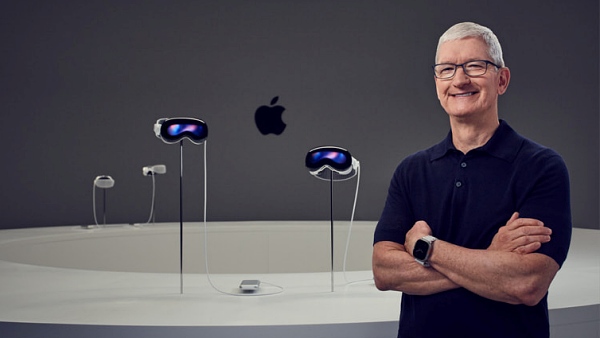
[DigitalToday reporter Hyunwoo Choo] Apple CEO Tim Cook (팀 쿡) will step down as Apple’s chief executive on Sept. 1, and Senior Vice President of Hardware Engineering John Ternus (존 터너스) will take over. On April 21 local time, IT media outlet TechCrunch reported that Cook has led Apple since succeeding Steve Jobs in 2011 and grew it into a company with a market value of $4 trillion.
Apple’s market value was less than $350 billion when Cook became CEO in August 2011, but it surpassed $1 trillion in 2018, $2 trillion in 2020, $3 trillion in 2022 and $4 trillion in 2025. Its current market value is $4.01 trillion. Net profit for the fiscal year ended September 2025 was $112 billion, up eightfold from September 2010.
Cook expanded Apple’s iPhone- and computer-centered ecosystem to wearables and peripherals. After launching the Apple Watch in 2015, Apple added blood oxygen tracking and electrocardiogram monitoring features. It drove change in the wireless earphone market with AirPods in 2016. In 2020, it released its first over-ear headphones. Apple Vision Pro, unveiled in 2024, was presented as a spatial computing platform but failed to win consumer support due to its price of several thousand dollars.
Apple also expanded its iPhone and iPad product lines. It added the iPhone SE and introduced Face ID and an edge-to-edge display. iPads expanded into a range of sizes and price points, broadening their use for personal, work and education needs. Apple began shifting from Intel processors to Apple silicon in 2020 and expanded it across the entire Mac lineup in 2023, boosting battery life, performance and power efficiency.
Growth in services has also drawn attention. Apple Pay has grown since its 2014 launch into a service used by 818 million people worldwide. Apple Music surpassed 112 million subscribers after launching in 2015, and Apple TV, started in 2019, won hundreds of awards including the Academy Award for Best Picture. Apple Arcade, introduced the same year, broadened its premium games portfolio. iCloud expanded through the 2021 launch of iCloud+, and the App Store maintained its 30 percent commission policy.
Apple’s services division generated revenue of $109.16 billion in the fiscal year ended September 2025. That makes up a substantial portion of Apple’s annual total revenue of $416.16 billion.
But it has not made a clear breakthrough in AI. Apple introduced Apple Intelligence in 2024, but an AI-based overhaul of Siri was delayed. Earlier this year, Google Gemini agreed to support Apple’s next-generation AI tools.
Cook’s 15 years saw Apple broaden its pillars beyond hardware to services, in-house chips and wearables. But as it failed to move as fast as expected in AI, a future growth area, Apple’s next competitiveness now depends on how quickly gaps are addressed under the successor Ternus.
 Hyunwoo Choo
cookinpapa@d-today.co.kr
Hyunwoo Choo
cookinpapa@d-today.co.kr