
[Digital Today reporter Sangyeop Oh (오상엽)] South Korea's Financial Supervisory Service called in comprehensive investment firms and urged stronger risk management across the operation of note issuance and integrated investment accounts (IMA), as well as investor protection.
The FSS held a meeting on April 21 at its headquarters in Seoul's Yeouido with heads of operations and audit divisions from seven comprehensive investment firms. At the meeting, it said the rapid growth in funding raised through note issuance and IMA has increased the firms' share in the market.
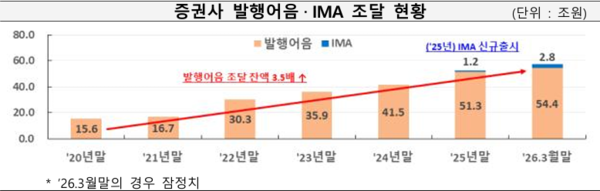
Outstanding balances of notes issued rose to 51.3 trillion won at end-2025 from 15.6 trillion won at end-2020, and expanded further to 54.4 trillion won as of a preliminary end-March figure. IMA also increased to 2.8 trillion won at end-March from 1.2 trillion won at end-2025.
Seo Jae-wan (서재완), a deputy assistant governor at the FSS, stressed that investor protection and risk management must not be neglected and that firms should have tighter internal controls than ever.
The FSS ordered firms to strengthen liquidity management for assets operated with issued notes, to secure their own response capacity even in stress situations such as worsening market conditions.
It said IMA also needs close, advance checks of asset liquidity when selecting investment assets so customers do not face disruptions in retrieving funds before maturity.
The most notable point at the meeting was the response to overseas private loan funds.
The FSS urged firms to communicate actively with overseas asset managers to obtain early information on redemption trends and loss 규모, and to promptly inform investors of relevant details, including re-submission procedures, if redemption limits occur.
It also said firms should analyse soundness and liquidity risks by major industry groups for overseas private loan funds and prepare pre-emptively for the possibility of risks emerging.
The order aligns with a recent trend in which regulators are looking at overseas private lending as a new risk factor for the securities industry.
Earlier this month, the FSS also called in securities firm executives over overseas private lending and urged stronger risk management, and it was reported to have begun a full survey to assess domestic securities firms' investment details and 규모.
Private loan funds have been criticised as vulnerable to liquidity shocks because their structure makes it difficult to immediately sell assets if investor redemption requests surge.
The market also offers an assessment that overseas private credit, or overseas private lending, is emerging as a new potential risk after a phase of clearing real estate project financing.
Korea Investors Service said in a recent report that after real estate project financing emerged as a key risk for the securities industry since 2022, it identified IMA and private credit together as key themes and risks for 2026.
Korea Investment & Securities is known to have invested part of its IMA funds in overseas private lending. Of the 2.559 trillion won in IMA funds it raised, 503.4 billion won, or 19.7 percent, was投入 into overseas private lending.
Looking only at the largest first product, 272.6 billion won, or 24.4 percent, of 1.115 trillion won was reported to have gone into overseas private lending.
Korea Investment & Securities has said the investment was a temporary allocation to operate funds until investing in domestic companies, or bridge assets in nature.
By contrast, Mirae Asset Securities did not invest in overseas private lending in consideration of the risk, and NH Investment & Securities was reported to be watching market conditions.
Korea Investors Service said, "Excessive concentration in specific assets is a factor that makes profit volatility very large when volatility expands in that market," and added, "Strict limit-setting and compliance are practical ways to prevent irrational overheating."
Separately, the FSS stressed not only risk management but also the firms' original role of supplying venture capital.
It said there is a need to build a capital market support system for innovative and venture firms, led by comprehensive investment firms, and that finding potential future growth companies and supporting their growth through equity investment is a role the firms can do "best."
To do that, it said firms need to raise standards for corporate credit screening and credit-risk management, and that the FSS plans to support capacity-building in the industry by preparing best-practice guidelines related to corporate credit provision.
The industry said it sees no problem with soundness for now.
Participants said they are supplying a total of 9.87 trillion won in venture capital in the first quarter of this year using not only IMA and note-issuance funding but also their own capital. They said that is 17.3 percent of the 57.2 trillion won raised through IMA and note issuance, above the 10 percent regulatory ratio for this year.
They also said they will broadly recheck internal controls across stages of customer asset operation and sales to protect investor interests.
An FSS official said, "We will continue to analyse the operating status of comprehensive investment firms, actively identify potential risk factors and guide improvements." The official added, "We will continue to check detailed conditions related to venture capital supply and push needed制度 improvements while communicating with the industry."
 Sangyeop Oh
yub@d-today.co.kr
Sangyeop Oh
yub@d-today.co.kr