
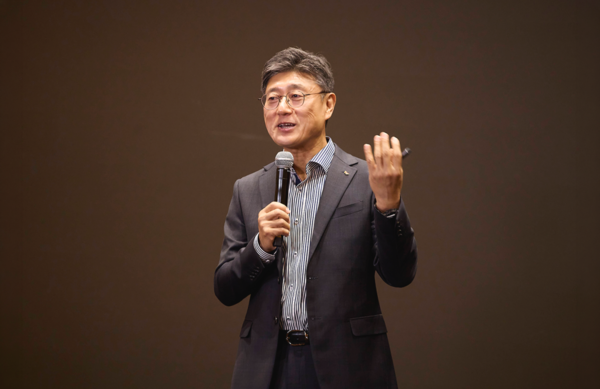
SK Telecom CEO Jeong Jae-heon (정재헌) held a town hall meeting marking six months since taking office and stressed the importance of customer-focused change. The company is speeding up changes to its structure, including creating an enterprise taskforce and revamping its job-level system.
SKT said Jeong used the town hall meeting on Monday to encourage employees who have actively moved to address an enterprise-wide crisis, and to share results achieved so far.
Jeong introduced the direction of change for the telecom and artificial intelligence businesses for future growth and a new corporate culture system. "In an era of disruptive innovation where the rise and fall of companies can be decided in a short time, we must evolve into a stronger corporate structure through continuous change," he said, stressing that key future growth engines all connect through AI.
In its telecom business, SKT is pursuing a two-track approach. It aims to build capabilities for mid- to long-term projects such as an AI-optimised integrated IT system, while continuing to strengthen its current digital competitiveness.
In particular, it will step up efforts to target the B2B market based on its capabilities as the country's only full-stack operator and its accumulated enterprise experience. SKT plans to create an enterprise taskforce reporting directly to the CEO to strengthen wired and wireless B2B competitiveness and secure new business opportunities in public and defence AI B2B. The taskforce will be headed by Myeong-jin Han (한명진), who will hold the role concurrently as head of the MNO CIC.
SKT also signalled an expansion of its AI data centre business. To boost execution, it will create dedicated units within the AI CIC, including an AI DC business division led concurrently by Seok-geun Jeong (정석근), head of the AI CIC, and an AI DC development division led by Min-yong Ha (하민용). The goal is to pursue a bolder scale-up by combining capabilities across SK Group affiliates and global partners.
SKT is also revamping its job-level system. It will introduce a Growth Level scheme that breaks its current two-tier structure of A and B bands into growth-stage practitioners (GL1), key contributors (GL2) and leaders and leader candidates (GL3). It will also create a job specialist track for those with outstanding professional expertise even if they are not managers, aiming to build a corporate culture that recognises front-line expertise.
Jeong said the company selected growth businesses and pushed organisational pivoting and changes to its HR system for plans spanning 10 and 20 years. He said visible results may be slow in the short term and the shift to AX could take more time, but urged employees to move ahead boldly for the future that would come after overcoming those challenges.
 Jin-ho Lee
jhlee26@d-today.co.kr
Jin-ho Lee
jhlee26@d-today.co.kr