
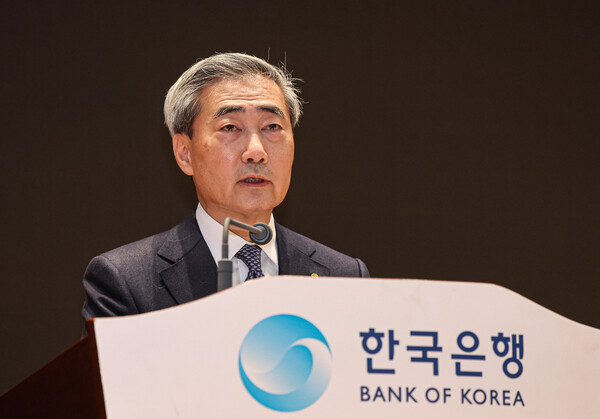
Shin Hyun-song (신현송), the new governor of the Bank of Korea, set out four core tasks in his inaugural address on Monday: "price and financial stability, internationalisation of the won, responding to digital currency and contributing to structural reform." It is a plan to redefine the role of the central bank amid Middle East-driven supply shocks and shifts in the financial environment.
On the conduct of monetary policy, Shin said, "uncertainty over the inflation and growth path has increased due to supply shocks from the Middle East war." He said he would pursue both price stability and financial stability through cautious and flexible policy management. He also stressed he would review policy tools to ease conflicts between policies, strengthen policy coordination with the government and enhance two-way communication with markets.
On financial stability, he signalled an approach that goes beyond the existing framework. He said, "the boundaries between banks and non-banks, and between domestic and overseas, are rapidly breaking down." He said he would strengthen early-warning functions by actively using market price indicators as well as soundness indicators. He also aims to strengthen the central bank's role in financial stability by widening the scope of analysis to include the expansion of the non-bank sector, off-balance-sheet transactions by financial institutions and non-traditional financial products.
Responding to internationalisation and digitalisation was also presented as a key pillar. Shin mentioned a push for 24-hour trading in the foreign exchange market and the creation of an offshore won settlement system to internationalise the won. He plans to raise the won's standing in the digital payments environment by improving the accessibility and stability of foreign exchange transactions to meet international standards, and by expanding the use of central bank digital currency (CBDC) and deposit tokens and joining international cooperation projects.
On structural reform, Shin made clear the central bank would expand its role. He said, "structural factors are not a separate area from monetary policy but an important part of policy operations." He said the bank would contribute to setting a desirable direction for the economy through in-depth research and policy recommendations.
On the direction of organisational management, Shin stressed improving organisational culture to strengthen staff capabilities, expanding cooperation across divisions and boosting productivity through the use of digital technology. He also said the bank would actively take part in discussions at international organisations such as the Bank for International Settlements (BIS) and the International Monetary Fund (IMF) to share South Korea's policy experience and contribute to shaping global discourse.
Shin said, "the tasks presented are by no means easy, but we can overcome them sufficiently based on the capabilities and experience of the Bank of Korea." He said he would deliver policy results along with changes in the organisation.
 Ji-young Lee
ljy@d-today.co.kr
Ji-young Lee
ljy@d-today.co.kr