
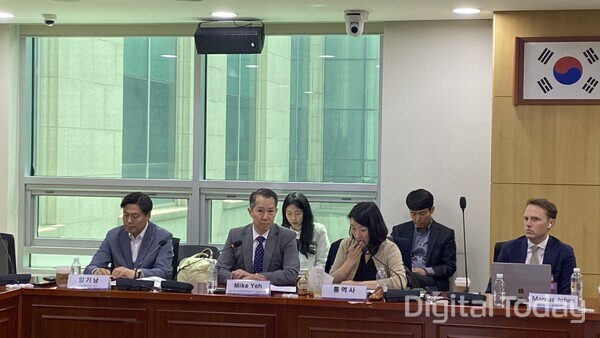
Microsoft emphasised an open AI ecosystem at a National Assembly event and voiced the view that South Korea needs to focus on corporate AI transformation based on semiconductor competitiveness rather than building a standalone large language model (LLM).
Mike Yeh (마이크 예), vice president in charge of policy and legal affairs for Microsoft Asia, said at a forum on building an open AI ecosystem held on April 21 at the National Assembly Members' Office Building in Yeouido that many countries have invested millions to hundreds of millions of dollars over the past four years to develop their own LLMs, but the only one that has gained any recognition is France's Mistral. Most countries have not succeeded in developing standalone LLMs, he said, adding that South Korea is no different.
Microsoft views South Korea's AI competitiveness as lying not in model development but in semiconductors and corporate AI transformation. Yeh said South Korea has outstanding capabilities in chip manufacturing and should concentrate investment in that area. He said linking consumer AI use to building enterprise software needs to lead to economic effects. He also mentioned the Cloud Security Assurance Program (CSAP) related to Azure and other services. Under the current structure, only Korean cloud service providers can be certified, he said, adding that this is not a policy based on openness.
An open AI ecosystem refers to a structure in which anyone can freely choose, use and trade AI services regardless of cloud or model type. Global big tech companies such as Microsoft and Google are making strategic moves to pre-empt global standards for their AI models or infrastructure with U.S. government support. In July last year, the Trump administration announced an "AI Action Plan" and specified a policy to foster open-source and open-weight models as a "global standard based on American values."
Lee Hae-min (이해민), a lawmaker from the minor Rebuilding Korea Party on the National Assembly's Science, ICT, Broadcasting and Communications Committee who hosted the forum, said openness and ecosystems are values that cannot be achieved if either is missing. She said an open AI ecosystem must be a prerequisite for companies, users and society as a whole to be sustainable.
South Korean experts also stressed measures to build an open AI ecosystem, including reforming procurement systems based on interoperability, clarifying the legal basis for using data for AI training purposes, introducing text and data mining provisions into the Copyright Act, and redesigning certification systems linked to global standards. Kim Min-kyung (김민경), an adjunct professor at the University of Hong Kong, said regulation is not the opposite of innovation but the infrastructure that enables it. She said what is needed is not more regulation but more sophisticated and predictable regulation.
The Ministry of Science and ICT said it agreed with the direction. Lee Jin-soo (이진수), director general for AI policy planning at the ministry, said developing an independent foundation model or sovereign AI is not the goal in itself. He said the three goals the government pursues are advancing technology, expanding services and improving the health of the AI ecosystem.
The government also said the opening of public data is already at the world's top level. Lee Se-young (이세영), director general for AI government policy at the Ministry of the Interior and Safety, said South Korea has maintained a top ranking since 2015 in the OECD assessment of public data openness. She said the ministry will select a list of 100 public datasets with high demand in the AI era through surveys of corporate needs and manage and open them in an AI-friendly way. Lee said she agrees with the value of an open AI ecosystem but that forming social consensus is needed at the stage of making it concrete. She said selection and concentration are inevitable in the early stage.
Domestic AI companies view support to secure global competitiveness as more urgent than full openness. Lim Ki-nam (임기남), an executive at Naver Cloud, said it remains difficult to access data in closed areas such as national defense, and that policy attention to that area would greatly increase use by private companies. From the perspective of a cloud service provider operating GPU-as-a-service, electricity costs directly affect service prices, he said, also requesting a reduction in the base power supply rate. Ham Jae-chun (함재춘), secretary general of the Korea AI Cloud Industry Association (KACI), stressed that rather than voucher support, there needs to be a real market in which public institutions can purchase domestic AI services.
The event was co-hosted by the Rebuilding Korea Party's special AI committee, lawmaker Lee and the Korean AI Law Society. Presentations were delivered by Kim Hyun-soo, head of the Digital Policy Research Division at KISDI, Park So-young, a legislative researcher at the National Assembly Research Service, and Kim Min-kyung, an adjunct professor at the University of Hong Kong. Participants in the discussion included Lee Jin-soo of the Ministry of Science and ICT, Microsoft's Yeh, Naver Cloud's Lim, KACI's Ham and Lee Se-young of the Ministry of the Interior and Safety.
 Seulgi Son
sageson@d-today.co.kr
Seulgi Son
sageson@d-today.co.kr