
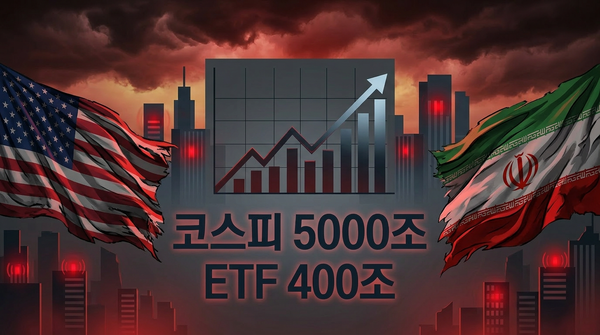
[DigitalToday reporter Oh Sang-yup] The market capitalisation of South Korea's stock market climbed back into the 5,000 trillion won range after weathering the shock from the Middle East war. Net assets of exchange-traded funds (ETFs) also topped 400 trillion won for the first time. But with instability in the Middle East continuing, some point to the risk of increased day-to-day volatility.
The KOSPI closed on April 20 up 27.17 points, or 0.44 percent, from the previous session at 6,219.09. While it held steady with its 52-week high of 6,347.41 in view, the ETF market, as of April 15, saw net assets exceed 400 trillion won for the first time.
Recent moves suggest the market is not in a one-way uptrend but in a phase of wider swings depending on external factors. Since late March, South Korean stocks have repeatedly shifted direction in line with Middle East-related news and oil prices.
Even amid this uncertainty, personal money flowing into equities has risen notably. Over the 14 months from January 2025 to February this year, the total amount of personal funds that moved into the stock market, including direct investment, customer deposits and cash management accounts (CMA), is estimated to have exceeded 140 trillion won.
In particular, new inflows in January and February alone totalled 45 trillion won. That brought the two-month amount close to last year's annual inflow. Individuals accounted for 57 percent of new money, and ETFs made up a large share, topping institutional investors.
Household asset shifts are also accelerating. An analysis says the trend of more than 160 trillion won in household assets moving into the stock market, centred on deposits, real estate and retirement pensions, is gaining pace.
With about 40 trillion won estimated to have left personal deposits, money from home sales has also likely flowed more into stocks since the second half of last year as the government tightened housing market regulations.
Some money is also returning from overseas stocks to the domestic market. Over the past four months, funds that left overseas stocks are estimated at 17 trillion won, only 7 percent of the 243 trillion won total in overseas stock holdings, leaving room for additional inflows, in one view.
With U.S. stocks accounting for 94 percent of all overseas stock holdings, the possibility remains open that inflows into the domestic market will increase as the return gap between South Korean and U.S. stocks widens.
The policy environment also remains a positive factor for stocks. In January, the government announced a comprehensive foreign exchange and capital market roadmap aimed at inclusion in the Morgan Stanley Capital International (MSCI) developed markets index and is speeding up institutional changes.
The key is to improve access for foreign investors. From July, the government plans to run the foreign exchange market 24 hours a day and build an offshore won settlement system to enable overnight won settlement between foreign institutions.
Work is also under way to streamline real-name verification procedures for foreign corporations and improve rules and systems so foreign individual investors can trade South Korean stocks more conveniently through local financial firms.
English-language disclosures will be made mandatory in phases, while the scope of filings will be expanded and deadlines shortened. The plan also includes exempting institutions participating in the Naked Short-selling Detection System (NSDS) from submitting duplicate audit materials, to reduce double regulation.
Authorities are also pushing capital market structural improvements, including revising delisting requirements, improving the practice of duplicate listings and shortening settlement cycles.
These are issues MSCI has repeatedly pointed out whenever it reviews the South Korean market. The focus is on building a foundation that lets foreign investors trust the domestic market and commit long-term funds.
Deputy Prime Minister Koo Yun-cheol (구윤철), who also serves as minister of finance and economy, met senior officials from major global investment banks and asset managers in New York on April 14, local time. He explained in person the status of South Korea's capital market reforms and the push to join MSCI's developed markets index.
At the meeting, Koo said $3 billion flowed in over three days after inclusion in the World Government Bond Index (WGBI) on April 1, and conveyed his resolve to make an all-out effort for MSCI inclusion.
Still, the risk remains that investor sentiment could shrink quickly if the Middle East situation worsens again.
In the securities industry, many see the KOSPI trading in a projected second-quarter range around 5,000 to 6,000, and the view persists that gains and losses will repeat for the time being depending on external variables.
Kim Dong-won (김동원), head of research at KB Securities, said, "This year, foreigners continued large-scale selling through March due to geopolitical uncertainty in the Middle East and profit-taking, but from the second quarter they are expected to expand the scale of buying." He said, "We judge that the KOSPI target of 7,500 points has entered into view."
He added, "The KOSPI market is recording the lowest valuation relative to profitability among global stock markets, and 2026 KOSPI operating profit is expected to hit a record high of 866 trillion won, up 182 percent year on year, helped by strong semiconductor performance centred on Samsung Electronics and SK Hynix."
 Oh Sang-yup
yub@d-today.co.kr
Oh Sang-yup
yub@d-today.co.kr