
Infineon Technologies is restructuring its business around a lineup of automotive microcontrollers (MCUs) based on RISC-V. Moving away from an ARM-based structure, it is adopting an open standard instruction set to strengthen automakers’ (OEM) leadership in development and reduce supply-chain lock-in risks.
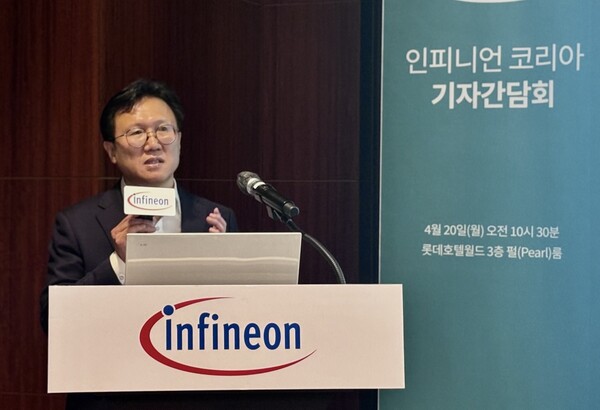
Infineon held a press briefing in Seoul on Sunday to announce its next-generation automotive microcontroller strategy and unveiled a roadmap for a new AURIX RISC-V lineup. The lineup supports the full range of automotive applications, from entry level to high performance. It will be added to the existing AURIX TC (TriCore-based), TRAVEO and PSOC portfolio.
The company said the core competitiveness of RISC-V is its open-source instruction set architecture (ISA). It said this allows hardware to be designed by selecting only the required instruction sets without dependence on a specific vendor, enabling both low-power implementation and optimisation of die area.
Jae-hong Choi (최재홍), vice president and head of technology for the automotive business division at Infineon Technologies Korea, said, "If an ARM core is off-the-rack clothing, RISC-V is a tailored suit." He said, "Because it is a structure developed together by engineers around the world, the ecosystem will expand to automobiles following the mobile and AI industries."
Choi defined RISC-V as the "Linux of semiconductors" or a "tailored suit" and presented three key values. They are safety and security that are favourable for implementing ISO 26262 and ISO 21434 certification, scalability spanning from entry-level to AI architectures, and its role as a hardware standardisation language that enables OEM-customised design.
Using RISC-V’s strengths in security, scalability and standardisation, Infineon said it will work with software and tool partners to provide a virtual prototype that can be used before actual MCU hardware is released. It said this will support shortening customers’ time to market through a "shift-left" development approach.
◆"We include only the needed functions"...Modular ISA maximises design efficiency
Infineon is jointly pushing commercialisation of RISC-V with major industry companies through its joint venture Quintauris. According to TechInsights, as of April this year Infineon’s share of the automotive MCU market is 36.0 percent, the highest globally. It gained an additional 4 percentage points last year alone. It plans to become the first semiconductor supplier in the industry to unveil an automotive RISC-V MCU lineup through this announcement.
RISC-V-based cooperation is ongoing. Thomas Boehm (Thomas Boehm), senior vice president of Infineon’s automotive microcontroller business segment, stressed that the shift to software-defined vehicles (SDV) is not a future issue but a current task, and cited a collaboration case with BMW as concrete evidence. BMW’s iX3, the first mass-produced model based on its next-generation architecture "Neue Klasse", includes more than 200 Infineon components, including high-performance microcontrollers, networking controllers, power semiconductors and sensors.
Boehm said, "Infineon is doing its best to establish RISC-V as an open standard for the automotive industry." He said, "Cars are now evaluated not by mechanical precision but by software intelligence." He said, "The key is how quickly new functions and updates can be provided."
Boehm also said, "In the era of software-defined vehicles (SDV), real-time performance and safe, security-enhanced computing, flexibility, scalability and software portability are more important than ever." He said, "RISC-V-based MCUs will meet these complex requirements while reducing the complexity of vehicle design and shortening time to market."
 Daegeon Seok
d2dg@d-today.co.kr
Daegeon Seok
d2dg@d-today.co.kr