
As major companies in the enterprise computing market accelerate moves to align AI agents across both hardware and software, Oracle is also stepping up efforts to optimise its core database technology for AI.
Oracle’s AI database strategy can be summed up as supporting secure, easy and non-dependent use by bringing AI to where data resides, rather than moving data to AI.
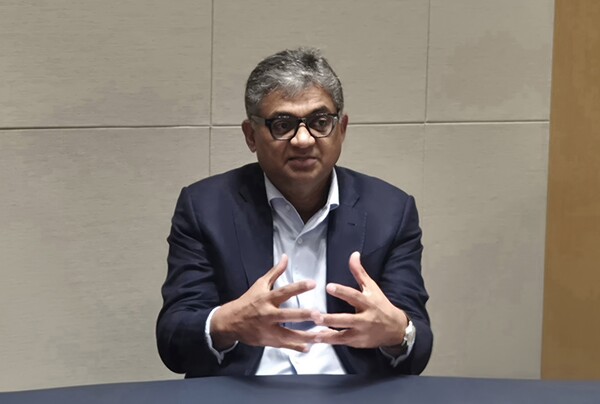
Hasan Rizvi (하산 리즈비), executive vice president in charge of database engineering at Oracle, stressed: "AI such as OpenAI ChatGPT and Anthropic Claude was trained on publicly available data. For companies to extract real value from AI, they must be able to use internal data securely. Oracle AI Database will be the optimal platform for this."
Oracle unveiled Oracle AI Database 26ai, a database optimised for AI.
According to the company, Oracle AI Database 26ai is designed with AI at the core of data management, with a focus on helping organisations apply AI to all data.
It positions itself as an AI-native database that uses AI across the data and development stack, including AI Vector Search, AI for database management, AI for data development, AI for application development and AI for analytics.
Rizvi said there are no difficulties associated with moving data for AI use. He said Oracle is integrating a vector database, removing the need for a complex process of converting existing database data and moving it to a separate vector database, again highlighting that AI can be used directly where data resides.
Oracle also directly integrated an agentic AI framework into the database along with the vector database. Rizvi said: "We will use agents a lot when developing systems and apps going forward. Database 26ai supports development of data-intensive apps inside the database. Not only can you develop apps using agents without moving data, you can also secure control over managing AI agents."
Simplification is another keyword Oracle stresses in its AI database strategy. Rizvi said: "If data is dispersed, it is difficult to implement AI. Oracle is therefore introducing a converged data engine, supporting everything from relational databases to document and vector data with a single data engine. To keep up with the rapidly evolving pace of AI, we must remove complexity."
Oracle also appears to be focusing on reducing data lock-in when companies use AI. As part of that effort, it revamped its lakehouse by focusing on support for Apache Iceberg, an open-source table format designed to manage large-scale data.
Rizvi said: "Oracle Lakehouse is evolving into an AI data hub that provides 80 connectors," adding: "You can apply AI not only to data in Oracle DB, but also to data on third-party platforms that support Iceberg."
Rizvi said the ability for users to use Oracle AI Database in a variety of ways also makes it an attractive alternative in terms of Sovereign AI, which is drawing attention in various countries.
He said: "Oracle DB can use a single converged data engine not only on-premises, on Oracle Cloud Infrastructure (OCI) as a public cloud, and in hybrid clouds, but also in third-party clouds. Management can be provided by Oracle, but self-management is also possible. You can freely move workloads across various environments. We are the most differentiated in data sovereignty."
 Chi-gyu Hwang
delight@d-today.co.kr
Chi-gyu Hwang
delight@d-today.co.kr