
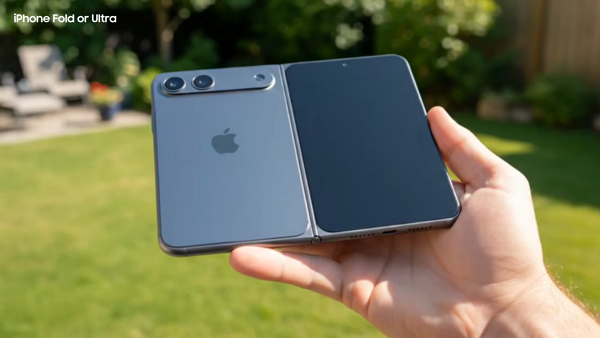
[DigitalToday reporter Kyung-min Hong] Apple is preparing an iPhone Fold that excludes Face ID as it pushes an ultra-thin design to the limit. It is also pursuing a bold design that introduces a dedicated camera control button to improve ease of use.
On April 19 local time, IT outlet PhoneArena reported that Apple is focusing on improving the hardware structure. It aims to overcome internal space constraints and allow intuitive one-handed control of camera functions even in a large-screen environment.
According to leaked specifications, the iPhone Fold is expected to be thinner, when unfolded, than the iPhone Air. Given that the iPhone Air is a model that emphasizes aesthetics, the iPhone Fold is effectively aiming for an even slimmer structure. The report said the design also creates structural constraints severe enough to make it difficult to include the Face ID module as internal space becomes heavily limited.
Even with those limitations, Apple has chosen to add a separate physical button for camera controls. The button may be placed at the top right of the device when unfolded. This is seen as a design intended to secure both space efficiency and functionality. Unlike existing touch-based controls, a physical button would allow key shooting functions to be launched immediately, with a major goal of strengthening usability.
Apple wants to keep the button to address repeated complaints about inconvenient one-handed operation on foldables. While existing foldable smartphones show strengths in using large screens, using both hands has been effectively essential when taking photos. Apple has redesigned the experience to enable shooting control without folding the device or changing posture. Its concept is to make major camera functions such as zoom adjustment and the shutter more intuitive to use.
These hardware changes are seen as an attempt to redefine how foldable smartphones are used, beyond simply adding a function. The industry believes Apple's design could influence product development directions at existing rivals such as Samsung and Huawei, and has raised the possibility it could further accelerate interface competition in the foldable market.
Ultimately, the success of the iPhone Fold depends on how naturally it links hardware innovation to the software experience. A key variable is how completely it delivers large-screen usability and an intuitive camera interface, and attention is on whether Apple can use this to establish foldable smartphones as a mainstream product category rather than an experimental device.
This approach shows Apple's strategic direction to redesign the overall user experience of foldable devices, beyond simple hardware improvements. The industry believes Apple's design could influence product development directions at existing rivals such as Samsung and Huawei, and has raised the possibility it could further accelerate interface competition in the foldable market.
 Kyung-min Hong
hongm@d-today.co.kr
Kyung-min Hong
hongm@d-today.co.kr