
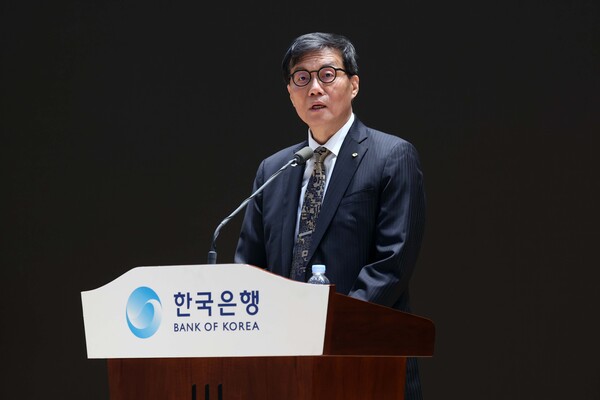
Bank of Korea Governor Lee Chang-yong (이창용) said on Sunday as he wrapped up his four-year term that it is becoming difficult to achieve economic stability and growth through monetary and fiscal policy alone. He stressed the need for structural reforms.
In his farewell address, Lee said the past four years were a time when policymakers had to respond to shocks beyond the expected range. He cited as a key policy response raising the policy rate to 3.5 percent, including two big steps, after inflation surged in the aftermath of the Russia-Ukraine war soon after he took office.
He said a complex mix of domestic and external crises followed, including instability in real estate finance, the collapse of Silicon Valley Bank in the United States, rising household debt and a sharp rise in the exchange rate. He said crisis management would have been difficult without the dedication of staff.
On achievements, he cited lowering inflation to the 2 percent range ahead of major central banks, introducing a Korean-style forward guidance and publishing more than 20 structural reform reports. He also called it a meaningful achievement that he became the first governor of a central bank in a non-reserve currency country to chair the Bank for International Settlements' Committee on the Global Financial System, and that the household debt ratio was turned onto a downward trend.
On the future policy environment, Lee said the role of monetary policy is more limited than in the past. He said policy effects are weakening due to changes in the economic structure, but expectations for policymakers remain high, widening the gap.
He also stressed changes in the structure of the foreign exchange market. He said it has become difficult to manage the exchange rate through interest rate policy or market intervention alone, as the influence of residents such as domestic companies and individuals and the National Pension Service has grown, not just foreign capital.
On low birth rates and low growth, he said the issues should be addressed through structural reforms in areas such as labour and education, not short-term prescriptions. On the semiconductor boom, he said it can contribute to economic stability but could also be accompanied by deeper dependence on a specific industry and polarisation.
On the role of the central bank, Lee said his view remains valid that the Bank of Korea should become the country's top think tank beyond monetary and financial policy, and he again stressed the importance of research into medium- to long-term structural reforms.
 Ji-young Lee
ljy@d-today.co.kr
Ji-young Lee
ljy@d-today.co.kr