
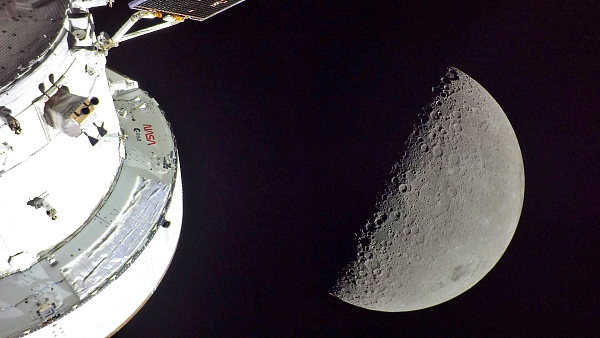
[Digital Today reporter Jinju Hong (홍진주)] The U.S. lunar mission Artemis II has demonstrated sharply improved data-transfer performance using laser-based communications, highlighting the potential of next-generation space communications technology.
TechRadar reported on April 18 local time that Artemis II demonstrated data transfer speeds up to 100,000 times faster than Apollo 13 using an optical communications system. It is assessed as a technical advance to meet the needs of modern space missions that must transmit large volumes of high-resolution images and telemetry data.
Modern lunar missions generate far more data than earlier efforts. Artemis II is expected to produce more than 300 to 400 GB of high-resolution images and telemetry data by the end of the mission, a qualitatively different level from missions in the 1960s and 1970s. Apollo 13 handled far less data. The difference is not a simple increase, but closer to a change in how spacecraft and Earth exchange information.
Infrared-based laser communications were introduced to respond to that change. Unlike conventional S-band radio communications, lasers use higher frequencies to transmit more data at once. NASA explained that this can dramatically increase data processing speed.
The laser-based optical communications system aboard the Orion spacecraft, O2O (Orion Artemis II Optical Communications System), showed performance of transmitting about 36 GB of data per hour. That is a sharp improvement over existing radio communications, which remained at about 7 GB per day.
Despite the technical achievement, challenges remain for operational use. Laser communications are heavily affected by weather, and signals can become unstable depending on clouds or atmospheric conditions. Ground receiving facilities therefore need to be built in dry, high-altitude areas.
The experiments were carried out in locations with favorable conditions, including White Sands in New Mexico and Table Mountain in California. The system, made up of small telescopes, gimbals and modems, was operated after several days of checks.
A NASA official described the result as meaningful, saying, "More data means more discoveries," but questions remain about the technology's maturity. The system is known not to be applied to Artemis III, the next lunar landing mission.
The figure of a "100,000-fold improvement" also has limits as a simple comparison. Apollo 13 communications technology was at a 1960s level, and critics say the gap with modern radio communications technology must be taken into account.
Experts say the key will be whether laser communications can operate reliably in deep space without frequent intervention from ground stations. Researchers at the Australian National University are testing the potential for scaling the technology by conducting experiments to receive laser signals using commercial components.
Ultimately, the result shows an important advance in space communications technology, but further verification is needed to demonstrate stability and practicality in a range of environments, the assessment says.
 Jinju Hong
hongjj@d-today.co.kr
Jinju Hong
hongjj@d-today.co.kr