
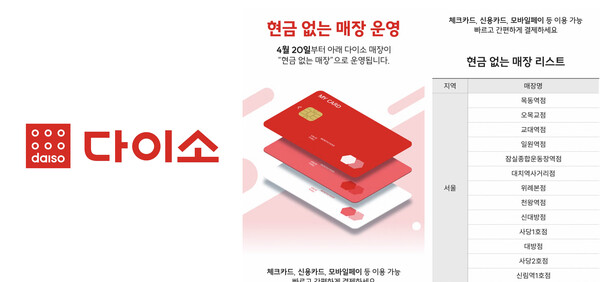
Asung Daiso is expanding “cashless stores”. It appears to be moving to overhaul its store operating system as card payments spread and the burden of cash management grows due to a сокращение in bank branches.
Industry officials said on April 20 that Asung Daiso will operate 73 stores nationwide as cashless from that day. Cashless stores are outlets where customers use debit and credit cards, mobile pay and other methods instead of cash when paying. Daiso said the 73 cashless stores include 13 in Seoul, 35 in Gyeonggi and 6 in Incheon, among others nationwide including the Seoul metropolitan area. Some of the stores have already been converted and operated as cashless outlets.
Daiso has operated a small number of cashless stores on a pilot basis since last year. Industry officials said Daiso was known at the time to have analysed customer purchasing patterns at the pilot stores to improve operating efficiency.
Asung Daiso cited recent changes in consumer behaviour and the financial environment as the background for introducing cashless stores. The company said it introduced cashless stores mainly at some outlets with a low share of cash payments as more bank counter branches are being reduced or closed.
When cash payments are made in stores, settlements are handled at bank counters, but recent reductions in bank counters are also causing operational inefficiencies such as time and physical constraints, it said. An Asung Daiso official said it is a way to improve store operating efficiency by reducing the burden of ancillary tasks such as managing possible errors in the cash settlement process, bank deposits and withdrawals, and closing settlements.
Given that Daiso has been steadily expanding its size recently, the expansion of cashless stores is seen as a move to overhaul its nationwide store operating system rather than a simple change in payment methods.
According to an audit report disclosed on the Financial Supervisory Service’s electronic disclosure system, Asung Daiso posted record results last year, with sales of 4.54 trillion won and operating profit of 442.4 billion won. Sales have maintained growth, rising from 3.46 trillion won in 2023 to 3.97 trillion won in 2024. Operating profit also rose 19.2 percent from a year earlier.
As of April 20, the number of Daiso stores nationwide was about 1,600, up from 1,576 a year earlier. With both sales and store count expanding, some analysis says the need to change store management systems has grown. Daiso said cashless stores have currently been introduced mainly at directly operated outlets. Daiso’s directly operated stores account for about two thirds of its 1,600 stores, or about 1,100 outlets.
Still, with only 73 cashless stores out of about 1,600 nationwide, it is too early to view it as a full-scale expansion. The industry sees Daiso as likely to review whether to expand further while watching operating efficiency and customer reactions in the future.
It has also been pointed out that since Daiso is a channel used by a range of age groups as well as younger generations, it needs to consider overall user accessibility so that inconvenience does not concentrate on certain age groups such as older people in the process of expanding cashless stores.
Asung Daiso said saving labour costs is not related to the expansion of cashless stores. An Asung Daiso official said the introduction of cashless stores was decided in a way that minimises customer inconvenience. The official said it is not aimed at cutting labour costs, but at reducing the work burden that could arise in the cash settlement process and focusing more on core tasks such as customer service.
 Shin-hye Ahn
doubletap@d-today.co.kr
Shin-hye Ahn
doubletap@d-today.co.kr