
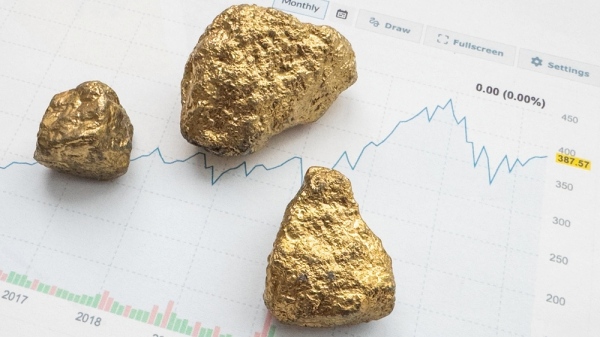
Gold prices have rebounded 18 percent from their March low, but an analysis says upward momentum is weakening instead.
BeInCrypto, a blockchain media outlet, reported on April 16 that gold was trading at $4,824 an ounce, up 18 percent from the March 23 low of $4,097. It said falling trading volume, a weakening gold-silver ratio and a simultaneous increase in bearish bets in the options market are emerging.
Gold has recovered to around $5,600, near its Jan. 29 peak, and is again approaching the upper boundary of a downward channel. On the surface, the rebound appears to be continuing, but there are signs in several places that actual buying is not strong.
In particular, in the rising stretch from March 24 to April 16, most consecutive bullish candles were accompanied by lower volume than before. Recent session volume was also limited to 159,110 contracts, and when real money typically drives an uptrend, volume should rise as prices approach resistance.
It is also a burden that silver is showing greater strength than gold. The gold-silver ratio, an indicator of the amount of silver needed to buy 1 ounce of gold, has fallen to 59.95. The ratio has dropped below the 0.618 Fibonacci level of 60.58 and is forming an inverse cup shape on the daily chart. A falling gold-silver ratio means silver is stronger than gold. Such a pattern typically appears when demand for safe assets weakens and risk appetite revives.
The market sees that the ratio must first regain 60.58 for gold to recover leadership. Even if it does, the pattern suggests the move could be limited to a rebound-handle zone, meaning risks are not fully removed. Another view is that regaining 65.47 is more important for gold to retake an advantage over silver in relative competition.
The options market is being read as a more direct warning signal. In options data for the SPDR spot gold exchange-traded fund (ETF), the put-call volume ratio rose to 0.70 on April 15 from 0.32 on April 1. Call options were heavily favored early in the rebound, but put option trading more than doubled as gold prices rose. The open-interest ratio, by contrast, showed little change at 0.55. This suggests new bearish bets are building without closing existing bullish positions.
By price, a box range between $4,751 and $4,953 is dividing the short-term direction. A move above $4,953 could be seen as a short-term bullish signal, but the key breakout line the market is watching is $5,155. This zone overlaps the 0.618 Fibonacci level and the top of the downward channel. For gold to break out of the bearish structure that has continued since January, it must close above $5,155 on a daily basis. In that case, the next target zones are presented as $5,443, $5,600 and then $5,810.
Conversely, failure to break above $5,155 could make bearish signals clearer. If $4,751 breaks, the next support is presented as $4,501, and if pressure from the lower end of the channel strengthens again, the possibility of a retest of $4,097 remains. In other words, $5,155 is the reference line that divides a breakout from a pullback, and an assessment says the current 18 percent rebound still lacks the strength to underpin confidence.
 Yoonseo Lee
yslee@d-today.co.kr
Yoonseo Lee
yslee@d-today.co.kr