
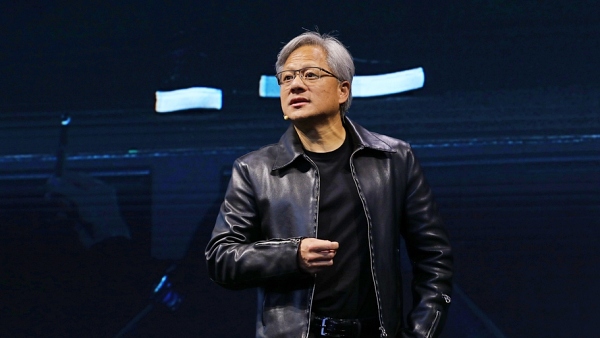
[Digital Today reporter Jinju Hong] Nvidia CEO Jensen Huang (젠슨 황) pushed back against claims by Anthropic CEO Dario Amodei that sharply criticised U.S. companies’ sales of advanced chips to China, calling them “madness” as the dispute intensifies.
Business Insider reported on April 16 that Huang, appearing on a recent podcast, directly criticised Amodei’s remarks comparing U.S. companies’ AI chip sales to providing nuclear weapons to North Korea. “It is madness to compare AI to those things,” Huang said, drawing a firm line in strong language.
The issue is how far the United States should allow AI semiconductor exports to China. Huang has repeatedly argued that the China market should not be abandoned. Amodei, by contrast, has stressed the need for export restrictions, saying advanced chips could lift the competitiveness of China’s AI industry.
Huang also rebutted a claim likening AI computing resources to enriched uranium, a key material for nuclear weapons. “We are not enriched uranium. They are just chips, and China can develop them on its own,” he said. His argument is that technology controls are not very effective and could instead cost the market.
In an essay published in January titled “The Adolescence of Technology,” Amodei assessed that China’s ability to produce advanced semiconductors lags the United States by several years. He argued there is no reason to provide additional technical support while that gap remains. The remarks were interpreted as effectively targeting U.S. companies’ chip sales to China.
Huang countered that it is a call “to give up the world’s second-largest market for no valid reason.” He also voiced concern about the possibility of a split technology ecosystem. If closed AI models form one ecosystem in the United States and open-source models build a separate one in China, U.S. technological influence could weaken.
The clash between the two figures is not new. Last year, Microsoft mentioned the possibility of investing up to $10 billion in Anthropic together with Nvidia, suggesting cooperation might be forming, but differences over chip exports to China have again become clear.
The policy environment is also a variable. Huang has lobbied the Trump administration and secured permission to sell the older H-200 AI chip to China. It partially reversed policies that had been restricted over national security concerns during the Biden administration. The approval came with a condition that the government takes 25 percent of sales revenue.
Actual business results are still limited. Nvidia has not yet recorded meaningful revenue from H-200 sales in China, and the U.S. government approval process is slowing the pace.
The dispute is spreading beyond a simple question of whether to allow exports to broader issues of U.S. AI industry strategy and technological leadership. Nvidia sees China as a core market, while Anthropic views the transfer of advanced computing resources itself as a strategic risk.
How the U.S. government sets a balance between security and industrial competitiveness is expected to significantly change the direction of the global AI supply chain and the technology ecosystem.
 Jinju Hong
hongjj@d-today.co.kr
Jinju Hong
hongjj@d-today.co.kr