
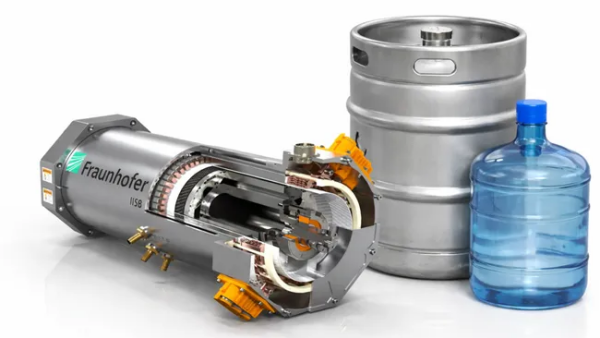
Germany's Fraunhofer Institute for Integrated Systems and Device Technology has achieved output of up to 1,000 horsepower with a compact, lightweight electric motor, setting a new marker in the race to electrify aviation.
TechRadar reported on April 16 that the institute's prototype motor weighs about 94 kg and produces close to 1,000 horsepower, or about 746 kW, achieving a power density of 8 kW per kg. That exceeds typical electric vehicle motors at 2 to 4 kW per kg and high-performance aviation motors at 5 to 6 kW per kg.
The motor has drawn attention for delivering high output from a compact structure about the size of a 12.5-kg gas cylinder. The outlet reported that while the Tesla Model S Plaid uses 3 motors to produce about 1,020 horsepower, this device reaches similar output with a single motor.
The technical core is innovation in structure and cooling. Researchers applied 4x3-phase hairpin windings instead of conventional copper-wire windings, placing more copper in the same space. That secured higher current and output while boosting mechanical rigidity and cooling efficiency.
The cooling method was also improved. It adopted direct oil spraying rather than air cooling, quickly reducing heat generation and enabling stable operation at high output. Fraunhofer emphasised that such a design is particularly important in aviation, where space and weight constraints are tight.
Key materials also contributed to performance gains. The motor uses 0.15-mm NO15 steel sheets. About half as thick as materials used in typical electric motors, the material reduces eddy currents to cut heat generated at high rotational speeds and improve efficiency. The motor can rotate at about 21,000 rpm.
A safety design for aviation use was also included. The motor is made up of 4 independent sections, each with its own windings, inverter and control system. If one section develops a problem, the remaining 3 continue operating, reflecting a redundant design intended to meet aviation safety standards.
The development was carried out as part of the European Union's Clean Aviation programme, Project AMBER. The project aims to cut carbon emissions from regional aircraft by at least 30 percent through hydrogen fuel-cell-based hybrid electric propulsion systems. The motor will be combined with Avio Aero's Catalyst turboprop engine, and GE Aerospace is also participating in the consortium.
Commercialisation still faces hurdles. A technical gap remains between prototypes validated at the laboratory level and hardware that has passed actual aviation certification. It is also still at the verification stage whether hydrogen fuel cells can reliably supply power on regional air routes.
Even so, the industry is assessing the achievement as an important advance in aviation electrification. The view is that integrating high output and light weight, cooling technology and redundant safety design into one system brings next-generation aircraft propulsion systems closer to real-world application beyond the research stage.
 Jinju Hong
hongjj@d-today.co.kr
Jinju Hong
hongjj@d-today.co.kr