
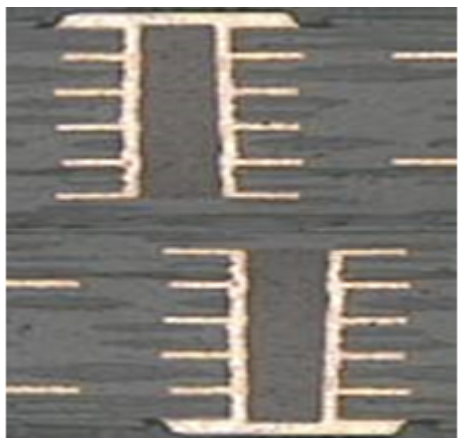
A supply shortage of high-layer printed circuit boards (MLB, Multi-Layer Board) is continuing due to a surge in AI demand, and a new market is opening up as far as the defense and aerospace sectors. MLBs are boards made by stacking multiple circuit layers. Unlike boards used in general electronic devices, they are high-reliability products required to operate without failure over long periods in extreme environments. They are used as key components in AI accelerators and network equipment that process large volumes of data at high speed.
The industry sees a clear trend of the demand base for MLBs expanding beyond AI. Boards for military equipment must operate for decades in extreme temperatures and under vibration, impact and shock. Boards for satellites must withstand space radiation and extreme temperature changes for more than 10 years without repair. As such, the defense and aerospace market, which requires high reliability, is emerging as a new growth axis for MLBs.
The aerospace market will begin to expand in earnest from this year. According to Hanwha Investment & Securities, domestic launches of very small and small satellites, based on Korea Aerospace Administration figures, are expected to surge from 14 last year to 100 in 2028 and 185 in 2030. Low Earth orbit (LEO) small satellites have a short lifespan of 3 to 5 years, structurally generating repeated production demand for constellation operations. Considering a satellite production lead time of 1 to 2 years, mass-production orders are likely to begin from 2026 to 2027.
Defense demand is also growing. The South Korean military is pushing to deploy up to around 130 low Earth orbit reconnaissance satellites by the early 2030s, and follow-on projects to the 425 programme and a very small satellite system project are set to proceed in sequence. Based on export results for weapon systems such as Cheongung-II, it is likely to expand the defense export domain to satellite and ISR (intelligence, surveillance and reconnaissance) systems.
◆Limited suppliers, surging demand... a structure that leaves only incumbents smiling
The problem is that this demand expansion is unfolding in a market already short of supply. MLBs have already entered a phase of structural shortage due to a surge in demand for AI accelerators and network equipment. AI accelerators such as Nvidia's H100 and B200 consume hundreds to thousands of watts of power and process ultra-high-speed signals. Their boards simultaneously require a high-layer structure of 20 layers or more, precise impedance control and the ability to carry high current. With demand from defense and aerospace added, some expect supply shortages to deepen further.
The industry views the shortage intensity within the board value chain as in the order of 'MLB > BVH HDI > glass fiber > CCL > circuit foil'. The MLB shortage is the most severe because the number of suppliers is limited and, given the high-reliability nature of the products, it takes years to expand capacity and obtain certification. Once a supply track record is built, customers do not easily change suppliers, a structure that strengthens incumbents' competitive advantages during a shortage.
If the MLB shortage deepens, price increases are inevitable. When demand structurally exceeds supply, suppliers' pricing power rises, leading to higher average selling prices (ASP) and improved profitability. In particular, because it is difficult to secure alternative supply lines for MLBs used in AI accelerators and for defense and satellite use, customers have little choice but to accept price increases.
On the demand side, bottleneck risks grow. For both AI server companies and satellite manufacturers, whether they can secure MLBs could become a variable in production schedules. If delivery delays occur, data centre construction schedules could slip, or satellite mass-production plans could face disruptions. The trend of long-term supply agreements (LTA), favoured in markets such as high-bandwidth memory (HBM), is likely to spread to the board market as well. An industry official said, "Because entry barriers are high, the market centred on existing board companies will be strengthened further."
 Dae-geon Seok
d2dg@d-today.co.kr
Dae-geon Seok
d2dg@d-today.co.kr