
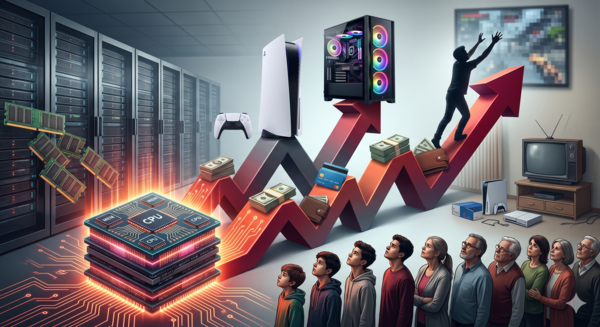
A shortage of memory semiconductors stemming from a surge in demand for artificial intelligence (AI) servers, so-called "chipflation", is shaking the broader games market. Prices for consoles and PCs are rising one after another, and pressure is spreading to software prices. Gaming, once seen as a representative "good value" hobby, is increasingly turning into an "expensive hobby". That is expected to make it difficult for South Korean game companies preparing next PC and console titles to avoid a direct hit on both demand and costs.
◆Hardware price rises sparked by surging memory prices
The root cause of chipflation is a supply-demand imbalance driven by a sharp rise in AI infrastructure investment. Chipmakers are concentrating resources on high-bandwidth memory (HBM) and server DRAM production, reducing supply of consumer memory used in PCs and consoles. In the first quarter this year, the revenue share of server DRAM and HBM reached 60 percent of total memory.
The scale of price increases is unprecedented. DRAM contract prices rose more than 50 percent from the previous quarter in the first quarter, while NAND flash rose more than 90 percent, market research firm Counterpoint Research said. TrendForce forecast additional increases in the second quarter of 90 to 95 percent for DRAM and 55 to 60 percent for NAND flash. Gartner expected overall PC prices to rise 17 percent by the end of this year along with sharp increases in DRAM and SSD prices.
The impact is directly pushing up finished product prices. Sony Interactive Entertainment (SIE) raised PS5 prices from April 2. The base model and digital edition each rose by $100 to $649.99 and $599.99, and the high-performance PS5 Pro rose by $150 to $899.99. It was an additional increase after about 8 months. If South Korean pricing reflects the change, the base model is expected to be around 1 million won, while the Pro model is expected to exceed 1.3 million won.
Microsoft (MS) has also been raising prices for the Xbox Series X and S in stages, and the possibility of additional increases is being discussed. Nintendo Switch 2 has not announced an official price increase, but shortages since launch have pushed actual market selling prices above 700,000 won. Market watchers say if chipflation persists, Switch 2 will also find it difficult to avoid price-rise pressure.
The gaming PC market is no different. The industry expects average PC prices to rise more than 20 percent further by year-end. Gartner also projected that the sub-$500 entry-level PC segment will disappear completely from the market by 2028. In the handheld gaming PC segment, Lenovo raised prices for its Legion Go 2 handheld devices by nearly 50 percent, with the base model increasing from $1,099 to $1,499 and the higher-end model from $1,349 to $1,999.
◆Price increases spread to software, will demand shrink?
As price hikes that started in hardware spread to software, gamers' perceived burden is growing on two fronts.
Steam, the world's largest PC game platform, revised its pricing calculation standards for 35 currencies on March 28. It raised the won-dollar exchange rate applied to South Korea by more than 20 percent, to 1,450 won from 1,150 won. In the revision, however, game companies can choose one of three methods: exchange rate-based, purchasing power-based, or multivariable pricing. Steam's recommended purchasing power-based price for a $69.99 game is 71,500 won, not much different from current levels. But if a publisher chooses exchange rate-based pricing, the domestic selling price for the same game would exceed 100,000 won. With the choice left to publishers, whether prices rise sharply depends on how each developer responds.
Concerns are growing that such cost increases will lead to lower market demand. Consumers actually rushed to buy ahead of the price rise. PS5 weekly sales hit a high for this year in the week immediately before the increase took effect, and total weekly game hardware sales in the United States doubled from a year earlier, according to market research firm Circana. That was seen as demand pulled forward ahead of the hike. After multiple increases, the cheapest PS5 model now sells for $200 more than at launch.
TrendForce forecast the global console market will contract 4.4 percent in 2026. Epic Games, developer of the hit game Fortnite, recently announced 1,000 job cuts and cited a slowdown in Fortnite engagement and broader weakening in consumption across the industry. The industry also expects a "delayed consumption" trend to spread further, with consumers waiting to buy after quality is proven. Console hardware typically became cheaper over time after launch, but current trends are moving in the opposite direction. As entry costs for new users rise, concerns are also being voiced that it will inevitably have a negative impact on securing the games market's potential demand base.
◆South Korean game companies fear direct hit ahead of major new titles
The fallout from chipflation is also reaching South Korean game companies. The industry has been developing large PC and console titles for years with the goal of targeting Western markets. These new titles are being developed to emphasize high-end graphics based on Unreal Engine 5, a structure that requires users to have high-performance devices.
The more device prices rise, the bigger the upfront cost burden for users who want to start gaming, which could directly hurt initial sales of new titles. On top of that, as the AI industry takes up large amounts of data center servers, server and cloud costs needed to operate game services are also rising. Market research firm Omdia said the cost shock will be bigger for game companies with a large share of live service games, multiplayer servers and large-scale backend operations. It is a phase in which higher entry barriers and rising operating costs are becoming visible at the same time.
Park Byung-moo (박병무), co-chief executive of NCSoft, said at a recent media briefing, "If there is a rise in semiconductor prices, I think it will come down at some point in the cycle. I believe it is important how you avoid that timing."
Some also raise optimism that blockbuster new releases such as "GTA 6" will drive game demand despite rising hardware prices. But analysis also suggests it is unclear whether the killer-content effect will materialise as broadly as before when console prices have risen above 1 million won. That is because the base of users able to absorb the cost burden itself is shrinking.
The prevailing view is that chipflation will persist until the end of next year, when new fabs stabilise. An industry official said, "The memory shortage is not a problem that ends with device supply disruptions. It is a cost shock across the games market that runs from console and PC price increases to software and subscription price adjustments, and rising server costs."
 Ho-jung Lee
lhj@d-today.co.kr
Ho-jung Lee
lhj@d-today.co.kr