
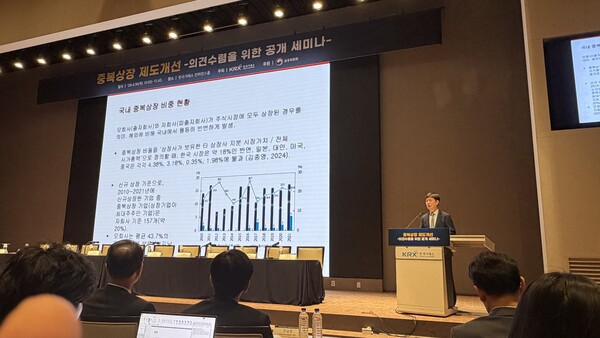
Nahyeon-seung (나현승), a Korea University professor, said frequent dual listings in South Korea’s capital market are a major cause of the “Korea discount” and that minority shareholders’ rights should be significantly strengthened.
Speaking at a public seminar on improving the dual-listing system held on April 16 at the Korea Exchange’s Seoul headquarters in Yeouido, Seoul, Nah said dual listings account for about 18 percent of South Korea’s market capitalisation. He said most major overseas markets are below 5 percent, including the United States at about 0.35 percent and Asian markets such as Japan and Taiwan.
He added that about 20 percent, or 157, of newly listed companies over the past 12 years involved a subsidiary listing while the parent company was already listed.
Nah cited “controlling shareholder incentives” as a reason dual listings are particularly frequent in South Korea.
Overseas, listed parent companies typically raise funds through paid-in capital increases and supply them to unlisted subsidiaries. In South Korea, he said, companies choose to list unlisted subsidiaries directly through initial public offerings to avoid dilution of controlling shareholders’ control that can occur in such capital increases.
He explained that some analysis finds that choosing a paid-in capital increase instead of a subsidiary IPO reduces controlling shareholders’ stakes by an average of 5 to 10 percent.
Nah pointed to a serious conflict of interest in this process. He said controlling shareholders expand business while maintaining control without additional contributions, while minority shareholders in the parent company face limits on direct ownership and voting rights in the subsidiary and see even their indirect stakes diluted.
He said the parent company’s stake in the subsidiary is ultimately not properly valued and that problems such as double counting of earnings push down corporate value. He said this is a fundamental issue linked to the Korea discount.
Nah said it was confirmed that the parent company’s share price rises slightly around the time a request is filed for review of a subsidiary listing, but then falls sharply after the listing date.
He said the parent company’s share price falls by an average of 11 percent, and by more than 16 percent on a median basis, through six months after the listing. While agreeing with financial authorities’ approach of “banning in principle and allowing exceptions,” he presented specific alternatives to protect minority shareholders.
He cited as the strongest measure a requirement for minority shareholder consent. He proposed introducing a Majority of Minority system requiring approval by a majority of the parent company’s minority shareholders, or limiting controlling shareholders’ voting rights to 3 percent at shareholder meetings to reflect minority shareholders’ views.
He also proposed, when a subsidiary listing is exceptionally permitted, giving parent-company minority shareholders priority allocation of new shares. He also proposed fully introducing a mandatory tender offer system to prevent dual listings through the tactic of acquiring part of a stake.
For existing companies where dual listings have already occurred, he advised applying soft rules, referencing the Japanese case, to require transparent disclosure of shareholder protection measures and future plans and to encourage a gradual unwinding.
Nah said an outright ban on dual listings could also risk discouraging controlling shareholders from investing in new businesses to maintain control. He said a balanced policy approach is needed to protect minority shareholders’ rights while maintaining investment.
 Sangyeob Oh
yub@d-today.co.kr
Sangyeob Oh
yub@d-today.co.kr