
[DigitalToday, reporter Jin-ho Lee (이진호)] South Korea's Ministry of Science and ICT said on Wednesday it is accelerating technology development to respond to climate change to implement government policy tasks and meet its 2035 greenhouse gas reduction target (NDC).
To achieve those goals, the ministry has established the 2026 implementation plan for climate change response technology development in line with the first basic plan for climate change response technology development.
According to the ministry, in 2025 it achieved 24.84 percent efficiency for an all-perovskite triple-junction solar cell, securing world-class efficiency. It built a CO2 demonstration plant based on private-sector cooperation, laying the groundwork for commercialisation.
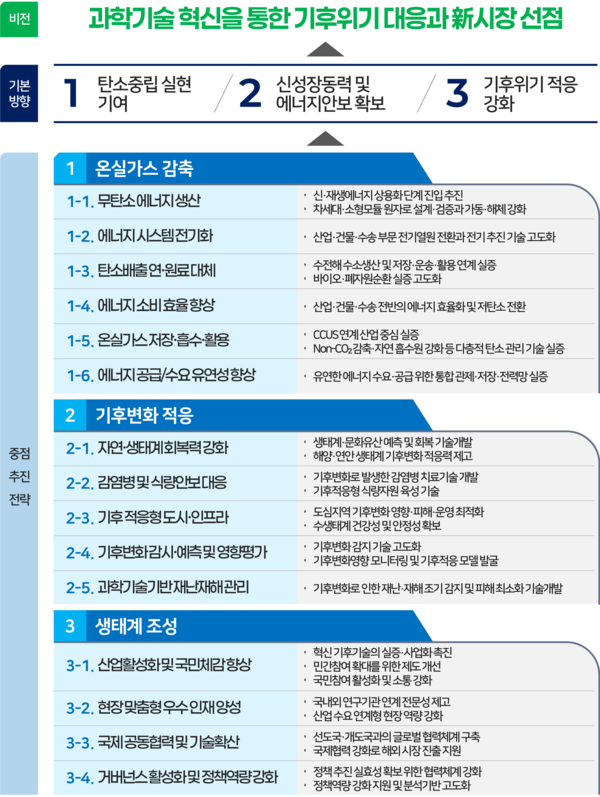
This year it will invest a total of 3.42 trillion won in three strategic areas: greenhouse gas reduction, climate change adaptation and building an innovation ecosystem. The amount is up 14.1 percent from a year earlier.
In greenhouse gas reduction, it will expand investment in carbon-free energy technology and broaden demonstrations linked to industrial sites. It will work to secure alternative energy technologies by developing next-generation solar cells, localising small modular reactor (SMR) technology and launching design work for a Korean innovative fusion reactor. It will strengthen the foundation for carbon neutrality through clean hydrogen development and large-scale carbon dioxide capture and utilisation (CCU) demonstration projects.
In climate change adaptation, it will build monitoring, forecasting and evaluation systems using digital technologies and artificial intelligence (AI). It will upgrade disaster response technologies by sector, including ecosystems, forests, urban areas and oceans, and improve the accuracy of short- and mid-to-long-term forecasts by increasing the precision of AI-based climate prediction technology. It will also pursue development of digital twin technology specialised for densely populated urban areas.
In building an innovation ecosystem, it will support the construction of climate technology demonstration infrastructure led by companies and local governments. Through international cooperation, it will promote the transfer and diffusion of domestic climate technologies overseas.
The ministry is also operating a pan-government climate technology consultative body to strengthen cooperation between the central and local governments. It plans to continue pushing technology development to realise a carbon-neutral society by checking related policies and the performance of projects.
 Jin-ho Lee
jhlee26@d-today.co.kr
Jin-ho Lee
jhlee26@d-today.co.kr