
The Korea Exchange will sharply raise the bar for reviewing duplicate listings of subsidiaries. It plans to give parent-company boards a duty of loyalty to shareholders and apply strict standards centered on three pillars: business and management independence, and investor protection.
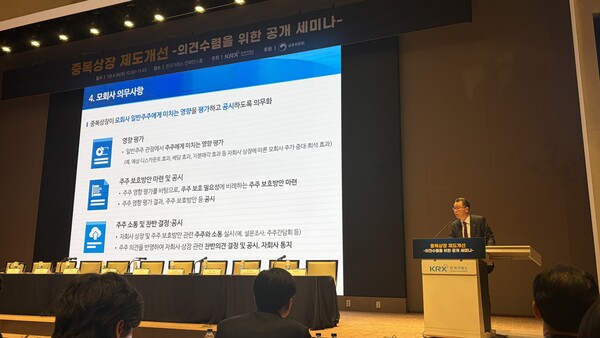
Lim Heung-taek (임흥택), an executive director at the Korea Exchange, presented the criteria at a public seminar on improving the duplicate listing system held at the exchange's headquarters in Yeouido, Seoul, on Wednesday.
Lim said the core of the overhaul was to set specific review criteria for duplicate listings in the exchange's listing screening. He said duplicate listings would in principle be banned, with strict standards applied only in exceptional cases.
The exchange will review cases in which a subsidiary under the effective control of a controlling company deemed an economic single entity, or an affiliate in a vertical control relationship, seeks a separate listing.
It cited representative types as the new listing of a company established through a listed firm's physical spin-off, relisting after a split-off aimed at converting into a holding company, and the listing of a newly established or acquired company. Lim explained that such cases create a need to protect shareholders of the parent company.
The review criteria for duplicate listings in those types fall into three broad pillars: business independence, management independence and investor protection.
Business independence will assess whether the company can survive and grow independently without relying on the parent company, in terms of similarities in key product customers or business models, technological self-reliance, and dependence in sales and distribution.
Management independence will evaluate whether the company has its own technology and personnel systems, whether board independence including an audit committee is secured, and whether the board can make substantive decisions without interference from the parent company.
Investor protection was presented as the most critical factor.
A key review item is whether the company sufficiently explained the background to the listing and the unavoidability of fundraising for general shareholders of the parent company.
The exchange also plans to comprehensively examine whether the firm made efforts for transparent communication through investor briefings or shareholder meetings, whether it took implementation steps proportionate to the need for protection, and whether it sought consent from general shareholders of the parent company and others.
Lim also mentioned past best practices for shareholder communication and protection measures.
He introduced cases in which, during physical spin-offs or the listing process of acquired companies, firms collected opinions through shareholder meetings and online surveys and faithfully reflected shareholder return policies such as cash and in-kind dividends, and the acquisition and cancellation of treasury shares.
He added that a special committee made up of outside directors conducted a shareholder survey, accepted opposing views and recommended to the board not to pursue a merger, eventually leading to a withdrawal of the merger, as a result in which shareholder communication was well reflected.
The exchange also plans to impose obligations, including a duty of loyalty to shareholders, on parent-company boards during the listing process.
Parent companies must directly assess the impact of a duplicate listing on general shareholders, prepare proportionate protection measures and disclose them.
They will also be required to disclose the decision for or against based on shareholder communication efforts and reflected views, and to notify the subsidiary.
Lim stressed that fair listing practices that do not undermine shareholder value must take root for the capital market to mature another step and level up to an advanced market. He said the exchange would work to restore market trust and develop the capital market through the push for the institutional overhaul.
 Sangyeop Oh
yub@d-today.co.kr
Sangyeop Oh
yub@d-today.co.kr