
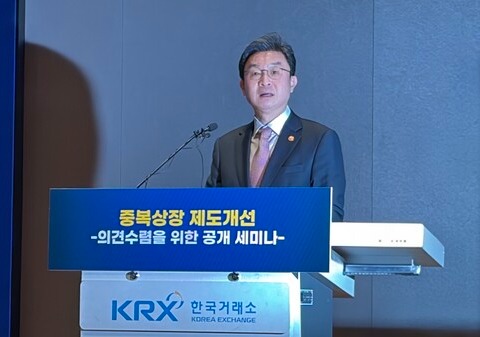
Financial Services Commission Chairman Lee Eok-won (이억원) said he will introduce strict and reasonable screening standards for dual listings under a "ban in principle, allow exceptions" stance.
Lee, speaking at a public seminar on improving the dual listing system held on April 16 at the Korea Exchange building in Yeouido, Seoul, called dual listings a long-standing capital market issue and a hurdle to progress. He stressed the need for institutional improvements to protect ordinary shareholders.
He said it is common in English-speaking countries for a parent to own 100 percent of a subsidiary and for only the parent to be listed.
He said large companies such as Apple and Meta do not list subsidiaries separately "not because it is legally prohibited, but because a practice has taken root of recognizing in advance and refraining due to possible conflicts of interest with minority shareholders and directors' legal liability" during dual listings.
He also said there is an underlying view that the value of a company, as an economic single entity, should not be calculated twice.
He said dual listings were widely carried out in Asia in the past under conglomerate-centered structures, but a trend is spreading to restrict them through strict reviews and stronger disclosures.
He said an understanding is taking hold among companies and markets, including in Japan, that dual listings, unlike ordinary listings, can fundamentally undermine shareholder value.
By contrast, he pointed to Korea, saying dual listings "have been carried out as a customary practice, and the ratio remains high compared with major countries".
Lee said criticism has been raised that controlling shareholders have used dual listings as a way to expand business divisions and affiliates while maintaining effective managerial control.
He added that there has also been an assessment that, because there is an incentive to lower a parent company's share price due to issues such as inheritance, dual listings have been chosen without the burden of a share price discount.
He said that "in this process, ordinary shareholders have not been able to fairly enjoy the results of subsidiary growth and have also borne share price discounts".
He stressed that it is time to address criticism that ordinary shareholders and controlling shareholders are standing on a tilted playing field, and to foster a fair and reasonable culture in the capital market.
He drew a line at banning dual listings unconditionally. He said they can be a means of raising funds to enhance corporate expertise and pursue a new leap, and that abuse should be regulated based on purpose and effects.
The Financial Services Commission has also presented a direction of banning dual listings in principle in the exchange's listing review and allowing only exceptional cases that meet comprehensive and specific criteria.
The government plans to strictly review whether a listing is fair to all shareholders and creates new value, or whether it is an asymmetric listing in which listing gains are concentrated on a few.
He also said the system will be revised so that when pursuing a subsidiary's dual listing, the parent company's board evaluates the impact on shareholders, prepares shareholder protection measures and maintains ongoing communication.
He said detailed standards and procedures will be prepared after sufficiently collecting opinions, and that after implementation, guidelines reflecting individual review results and best practices will also be supplemented.
Lee said, "Ordinary shareholders are no longer a silent majority," and that the capital market has clearly changed from the past.
He said that through three revisions to the Commercial Act, directors must treat the interests of all shareholders fairly, and it has become no longer possible to hold treasury shares for the purpose of protecting controlling shareholders' management rights.
He stressed that as the perception that a company belongs only to controlling shareholders is improving, systems and practices should also be normalized step by step.
He urged companies to view shareholders not simply as a source of financing, but as partners that grow together.
 Oh Sang-yup
yub@d-today.co.kr
Oh Sang-yup
yub@d-today.co.kr