
With the European Union beginning legislation on the Digital Networks Act (DNA), attention is focusing on where it intersects with South Korea's telecom issues, including spectrum allocation and network usage fees. A recommendation is for South Korea to refer to the bill and take a more challenging stance, including to spur network investment.
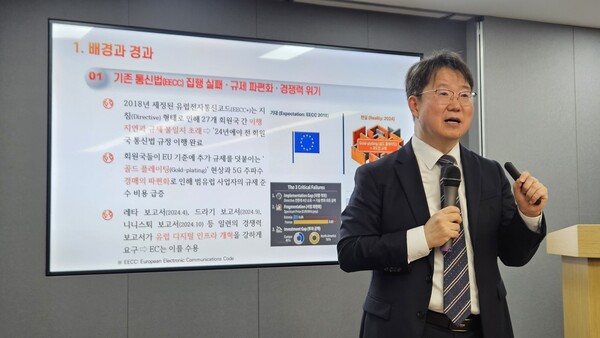
Cho Dae-geun (조대근), an adjunct professor at Sogang University, introduced trends and implications of the EU DNA legislation at a telecom industry insights seminar hosted by KTOA on April 15. The EU DNA centres on scrapping the existing European Electronic Communications Code (EECC) and integrating telecom regulation, which differed by member state, into a single system. Cho analysed it as a paradigm shift in spectrum policy, saying it redefines spectrum as a strategic public asset.
Under the existing EECC system, 27 countries applied different telecom rules, fragmenting the market. As a result, telecom operators in each European country were unable to achieve economies of scale, Cho said. Including a provision guaranteeing spectrum rights for at least 40 years is intended to make it easier for telecom operators to establish mid- to long-term investment plans.
In South Korea's telecom industry in particular, there have been persistent arguments that the current system centred on spectrum auctions could constrain investment capacity. Telecom operators say repeated renewals at set intervals and high spectrum fees can burden long-term network investment.
The EU DNA, by contrast, focuses on minimising market burdens, including investment incentives such as extending spectrum licence periods. Cho said attention should be paid to approaches that promote investment, and that institutional support at the national level and bold challenges by market participants are required.
There is also a need to refer to the EU DNA in discussions on network usage fees, including concerns about global over-the-top services free-riding. In South Korea, conflict has continued between internet service providers (ISPs) demanding network usage fees and content providers (CPs) refusing them. Multiple related bills have been introduced, but no clear solution has yet emerged.
The EU DNA chose an approach in which national regulatory authorities (NRAs) intervene but ultimately leave matters to market autonomy. When disputes arise between operators, an NRA convenes a mediation meeting and arbitrates, but leaves a record to create a type of precedent. Because a case in which an NRA sided with one party could become a standard for judging future disputes, the goal is to encourage negotiations between operators before state intervention.
Cho interpreted this as also intended to leave ISPs a channel to secure funding and promote investment sustainability. He said it is a system that allows ISPs to recoup the costs of earlier investment and raise another source of funding.
The EU DNA is still at the proposal stage, so reviews and revisions are expected to continue until it is fully implemented. Still, with domestic telecom operators having continued to call for institutional mechanisms for network investment, the current bill is expected to be a major reference for future domestic legislation and policy direction.
The industry is focusing on the point that the EU DNA goes beyond simple regulatory integration and represents a shift to investment-centred regulation. This is because, as South Korea discusses 5G standalone (SA) and the introduction of 6G, long-term spectrum policy and network investment incentives are key variables that will determine telecom industry competitiveness.
Cho said regulations must be designed transparently and clearly to promote network investment, and that a balanced approach is needed so innovation and user protection can coexist in harmony.
 Jin-ho Lee
jhlee26@d-today.co.kr
Jin-ho Lee
jhlee26@d-today.co.kr