
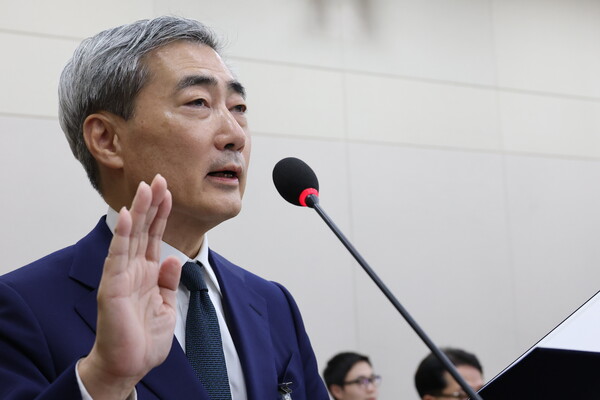
[DigitalToday reporter Lee Ji-young] Shin Hyun-song (신현송), nominee for Bank of Korea governor, issued a formal apology over controversy involving his personal matters.
Appearing at a confirmation hearing of the National Assembly’s Finance and Economic Planning Committee on April 15, Shin said there was a lapse in failing to properly handle administrative processing during many years of living overseas. He said he was deeply sorry to have caused concern to the public over personal issues.
Shin said there was no intentional act aimed at pursuing any benefit. He said he would promptly address the issues raised and do his best for the South Korean economy.
At the hearing, lawmakers also focused on issues related to Shin’s assets and family. Key points included owning 3 homes at home and abroad, all family members holding foreign nationality, and more than 90 percent of his financial assets being in foreign-currency assets.
They included that he bought an apartment in Seoul’s Gangnam district with a jeonse lease in place and made a capital gain of 2.2 billion won after 11 years, and that his mother lived without paying a jeonse deposit.
Shin said a significant portion of his foreign-currency assets had been sold and brought into South Korea in won, and he would continue to reduce them. He stressed he would put all matters in order without conflicts of interest.
On transactions involving his mother, Shin said it was not for speculative purposes or a so-called gap investment. He said he bought the home as a way to support living expenses. He added that if it is considered a gift, he would verify it through a tax agent and take necessary steps.
EXCHANGE RATE, MONETARY POLICY IN FOCUS; STABLECOIN ROLE ALSO SET OUT
Shin also laid out his stance on recent exchange-rate moves, the direction of monetary policy and digital currencies.
He said it is true the won-dollar exchange rate has remained at a high level in recent months. He said it appears that a 'tail wagging the dog' phenomenon emerged as off-balance-sheet derivatives trading expanded.
Shin said the core of monetary policy is price stability. He said a monetary policy response would be needed if Middle East risks persist and lead to rises in core inflation and inflation expectations.
On digital currencies, Shin presented a view that stablecoins and central bank digital currency-based deposit tokens could operate in parallel.
Shin said stablecoins and deposit tokens each have a role within the monetary ecosystem. He said they could be used in a way that is complementary while also competitive.
He also reaffirmed the need for a bank-centred approach to the issuance structure for won-denominated stablecoins.
He said the proposal is based on the premise that banks can best carry out customer verification. He said fintech firms can also play a sufficient role within a consortium.
 Lee Ji-young
ljy@d-today.co.kr
Lee Ji-young
ljy@d-today.co.kr