
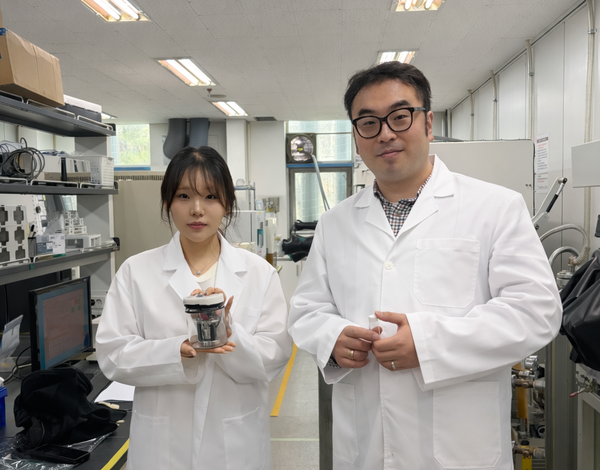
The Korea Institute of Industrial Technology, or KITECH, said on Tuesday it has developed a material that simultaneously improves ionic conductivity and air stability in sulfide-based solid electrolytes, a key material for all-solid-state batteries. A research team led by senior researcher Kim Tae-hyo (김태효) at KITECH's Low-Carbon Energy Group succeeded in improving ionic conductivity by 77 times versus existing material and reducing toxic hydrogen sulfide generation by 40 percent.
Solid electrolytes serve as a pathway for lithium ions to move between the cathode and anode inside all-solid-state batteries. Among them, sulfide-based electrolytes are seen as a leading candidate material because of their high ionic conductivity.
The team focused on a sulfide-based solid electrolyte, lithium six phosphorus five iodide (Li6PS5I). The material has low manufacturing costs and forms a lithium iodide (LiI) nano protective layer when it contacts lithium metal, which helps improve cell stability. It has drawbacks, including relatively low ionic conductivity among sulfide-based solid electrolytes and generation of toxic hydrogen sulfide when exposed to moisture.
To address this, the team combined three elements with different roles in Li6PS5I: chlorine, antimony and oxygen. Chlorine changes the atomic arrangement inside the material to facilitate lithium-ion movement, while antimony and oxygen create a bonding structure that is resistant to moisture, suppressing material decomposition and hydrogen sulfide generation.
The team compared and verified various compositions by gradually adjusting the ratio of the three elements and derived a composition with an optimal balance of ionic conductivity and structural stability. Tests showed the ionic conductivity of the developed material rose to 1.158 mS/cm, up 77 times from the existing material. In an environment with 30 percent relative humidity, hydrogen sulfide generation fell 40 percent, improving resistance to moisture. When exposed for 24 hours at 50 percent relative humidity, existing material deteriorated into a mud-like state, while the developed material remained solid.
Stability with lithium metal also improved. The limiting current value, which the battery can withstand until just before an internal short circuit, rose 86 percent versus existing material, and the team said it confirmed stable operation for more than 2,000 hours while in contact with lithium metal.
The team went beyond material design and assembled a pressure cell to verify cycle performance. The initial discharge capacity of an all-solid-state cell using the developed solid electrolyte was 158.4 mAh/g, up 18 percent from a Li6PS5I-based cell at 134.5 mAh/g. Stable operation was also confirmed in a durability test of 100 charge and discharge cycles.
Kim said the work confirmed the possibility of developing materials that improve both performance and stability in sulfide-based solid electrolytes. He said the team plans to accelerate commercialisation of all-solid-state batteries by transferring the technology to domestic materials, parts and equipment companies. The research was published in the international chemical engineering journal Chemical Engineering Journal.
 Seok Dae-geon
d2dg@d-today.co.kr
Seok Dae-geon
d2dg@d-today.co.kr