
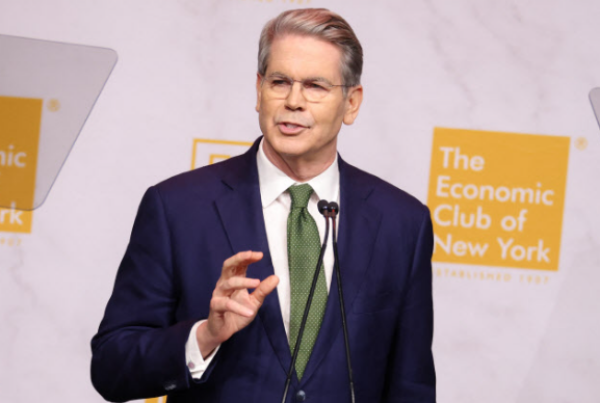
[DigitalToday reporter Jinju Hong] U.S. Treasury Secretary Scott Bessent said the Federal Reserve does not need to rush to cut interest rates as uncertainty has increased due to the Iran war.
On April 14 local time, blockchain media outlet cryptopolitan reported that Bessent said at the Semafor World Economy event in Washington that he did not deny the need for rate cuts, but that watching and waiting should come first for now.
On the direction of rates, he said, "I ultimately think rates need to go down, but right now we should wait and see." He made clear that Middle East variables have made monetary policy decisions more complex, even as President Donald Trump continues to pressure the Fed to lower borrowing costs.
Bessent assessed that the U.S. economy had shown strong momentum before the impact of the Iran war intensified. He said it was right for the Fed to maintain a wait-and-see stance for now.
He said recent price increases were unlikely to become entrenched in inflation expectations. The U.S. government released March inflation data on April 11 showing the pace of inflation rose three times faster than in February, influenced by increases in oil and gas prices. Core inflation excluding food and energy was lower than expected. Citing this, Bessent said he saw a low likelihood that recent price pressures would harden into long-term inflation expectations.
He declined to answer directly whether the Iran war would be positive or negative for the U.S. economy. Instead of a specific judgment, Bessent said, "After 50 days or 100 days, this period could be assessed as a time that led to 50 years of stability."
He also became somewhat more cautious about the growth outlook. In February, he said the U.S. economy could grow more than 4 percent this year, but when asked if he still held that view now, he replied, "There are clearly parts we need to make up for."
He also mentioned Kevin Warsh, who has been nominated as successor to Fed Chair Jerome Powell. Bessent said he looks for someone with an open mindset as a selection criterion, and said Warsh would closely examine how regional Federal Reserve banks operate and interact. He also pointed to as a problem a structure in which about 50 percent of staff at each regional Fed bank do not report to the president.
Warsh's confirmation process is being delayed by paperwork delays and opposition in the Senate. North Carolina Senator Thom Tillis is blocking final approval until a federal criminal investigation related to Powell under the Trump administration is resolved. Warsh's Senate hearing was scheduled for this week but was postponed due to paperwork issues, and the earliest schedule is next week.
Warsh's wealth has also emerged as another variable in the confirmation process. According to financial disclosure forms, Warsh's own assets are about $131 million to $209 million. In addition, his spouse Jane Lauder separately holds assets worth hundreds of millions of dollars. This far exceeds the asset levels of recent Fed chairs. In Powell's 2025 financial disclosure forms, assets were between $19 million and $75 million. Warsh has said he will dispose of those assets if confirmed.
With both the rate path and the confirmation timetable uncertain, inflation trends and the Senate hearing are expected to draw attention together.
 Jinju Hong
hongjj@d-today.co.kr
Jinju Hong
hongjj@d-today.co.kr