
Competition to secure users in the delivery platform industry is intensifying, adding to pressure on profitability. Baedal Minjok, known as Baemin, and Coupang Eats are waging a fierce market share battle through discount promotions, rider hiring and expanded new services, while related spending is also rising. Diversifying revenue sources into areas such as commerce is emerging as a key task.
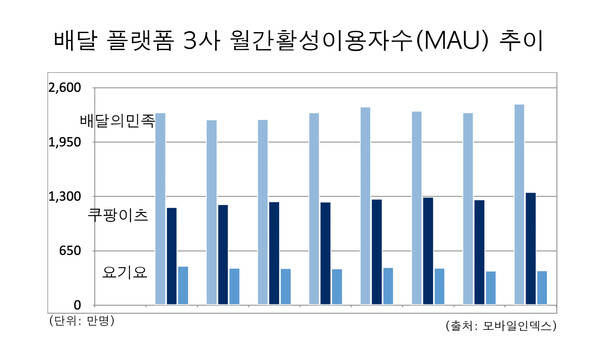
Industry officials said major delivery platforms such as Baemin and Coupang Eats have continued their user acquisition battle this year. Mobile Index data showed monthly active users in March stood at 24.09 million for Baemin, 13.55 million for Coupang Eats and 4.18 million for Yogiyo.
Compared with August last year, Baemin rose to 24.09 million from 23.06 million and Coupang Eats climbed to 13.55 million from 11.74 million. Yogiyo fell to 4.18 million from 4.70 million. Baemin remains in the lead, while Coupang Eats is rapidly increasing users and stepping up the chase.
As the market share battle continues in the delivery platform industry, the burden of marketing costs is also growing. Spending to secure users is rising through discount promotions, rider hiring and expanded new services. Industry officials see the burden of defending profitability growing as competition persists, separate from top-line growth.
The competition is also reflected in results. Woowa Brothers' earnings release showed consolidated revenue last year rose 22.2 percent from a year earlier to 5.283 trillion won. Woowa Brothers exceeded 2 trillion won in revenue for the first time in 2021 with 2.009 trillion won, and continued to expand to 2.9471 trillion won in 2022, 3.4155 trillion won in 2023, 4.3226 trillion won in 2024 and 5.2829 trillion won in 2025.
Coupang Eats is also sustaining growth. Coupang Inc's earnings release for last year showed revenue in its developing offerings segment, which includes Coupang Eats, rose 32 percent from a year earlier to about 2.069 trillion won. It is interpreted as expanding its user base by widening user touchpoints through links to Coupang membership and the commerce ecosystem. As Coupang Eats, once a latecomer, rapidly increases users, the competitive landscape in the delivery app market is also becoming clearer.
Woowa Brothers' operating profit, however, fell to 592.9 billion won in 2025 from 640.8 billion won in 2024 and 699.9 billion won in 2023.
Woowa Brothers said higher costs tied to discount and event promotions, investment in new services and rider hiring contributed to the decline in operating profit. As the delivery platform market enters a mature phase, it is difficult to maintain user loyalty through simple order brokerage alone, and the burden of investment in price benefits, delivery execution capabilities and service differentiation has also grown, it said.
Baemin started its "Hangureut" service in May last year, allowing single-serving menus to be delivered by single-order delivery. Delivery fees rise by 1,000 won, but as it is a new service, Baemin provided support of up to 2,000 won per delivery fee to platform partners for budget and single-order deliveries. A Woowa Brothers official said, "After the launch of the Hangureut service, costs related to per-order amount support promotions and rider hiring increased."
Industry officials, meanwhile, are moving to shore up profitability by expanding new businesses as cost burdens from the market share battle grow. Baemin is strengthening its quick commerce business centered on B Mart and widening its revenue base through brand collaborations and other initiatives. Last year, product sales including Baemin B Mart rose 3.2 percent from a year earlier to 781.1 billion won. That was up 85.2 percent from 421.7 billion won in 2021. Some in the industry also say B Mart, a direct-purchase-based commerce business, is showing growth and establishing itself as a new source of revenue.
Attention is also on whether the franchise partnership model "Baemin Only," introduced last month, will affect profitability improvement. Baemin Only is a partnership business that lowers brokerage fees to 3.5 percent from 7.8 percent and supports promotions on the condition that a specific brand does not join competing platforms.
Coupang Eats is also expanding quick commerce services. It is widening its business scope by offering free delivery of grocery and shopping category products through partnerships with big-box marts and convenience stores. Some in the industry say competition among delivery platforms is expanding beyond simply securing market share into a race to secure additional revenue sources such as quick commerce, advertising and partnership models.
Industry officials expect the market's competitive structure will also change depending on how quickly each platform builds a stable profit structure rather than stopping at top-line growth.
An industry official said, "As competition in the delivery platform market intensifies, investment continues to attract users and strengthen service competitiveness." The official added, "In the mid to long term, moves to diversify the revenue base through various businesses such as commerce, quick commerce and advertising will continue." The official also said cost burdens from competition to secure riders are also likely to persist for the time being as the market share battle continues.
 Shin-hye Ahn
doubletap@d-today.co.kr
Shin-hye Ahn
doubletap@d-today.co.kr