
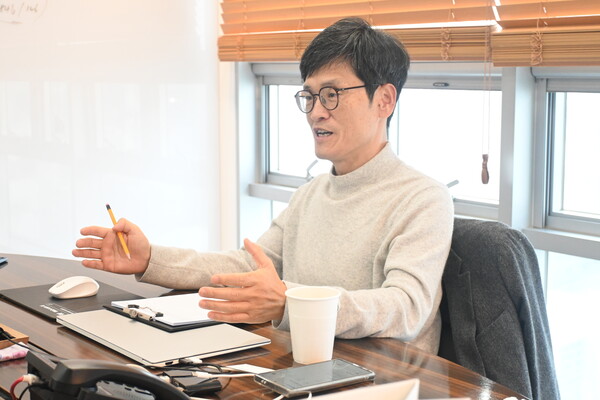
[DigitalToday reporter Chi-gyu Hwang] "In financial markets, AI is a technology paradigm with a different texture from the internet and mobile. In the pre-internet era, bank employees handled banking. In the internet and mobile environment, customers did. In the AI era, AI agents will carry out finance based on customer instructions. This trend will take concrete shape in South Korea in the second half of the year."
Wan-soo Yoon (윤완수), vice chairman of B2B fintech platform company Webcash Group, summed up the change that AI agents will bring to financial markets this way. From the perspective of who performs finance, he said AI is a paradigm that sits on the opposite side from the internet and mobile, meaning the intensity of change is bound to be greater.
Many details remain hidden and unclear, but Yoon sees companies like Webcash, which sell financial solutions, as facing a calm-before-the-storm situation because of AI agents. He cited that while the essence of the banking business will not change even in the era of AI agents, the way software operates will change by 180 degrees.
Yoon said existing software is screen-based, but screens disappear in an AI-agent environment. He said it will shift from a click-based access system to a call system centered on questions and instructions. He forecast that from the second half of this year, banking channels will evolve into AI agents over the next 2 to 3 years.
Faced with a massive change layered with uncertainty, companies have two options: a wait-and-see mode and a pre-emptive response. Webcash chose a course of responding as early as possible through an AI-agent-first strategy.
Yoon stressed that while many companies remain quiet because they have yet to find answers, Webcash is already transforming into a company that provides agents in its software. He said the group is converting its main products into AI agents and has started providing some to customers.
Yoon also stressed that the company is not adding AI agents to existing software, but approaching AI agents separately from existing software. He said it would initially install AI agents into software-as-a-service, but in essence would approach them as a different product. He made clear the company will provide AI agents as standalone products rather than add-on features to existing products.
At present, Webcash's AI-agent business strategy can be summed up as converting CMS, a B2B fintech cash-management service, to be centered on AI agents; supporting financial companies in building agent banking services; and building an environment in which AI analyzes big data from financial companies' internal management information systems, or MIS.
Among these, the CMS conversion is a case of changing the flagship product to be AI-agent-centric, which Webcash sees as symbolising its AI-agent-first strategy.
Yoon said it would complete work to convert CMS into an AI agent during the first half of the year. He said the AI cash assistant BranchQ began service for customers in April. He also stressed that converting Webcash CMS into an agent would expand its potential further, adding that it now mainly covers cash management but applications could grow.
Building big data-based MIS and agent banking services will be 추진 in the form of system integration projects. As it is a new business, the company appears to expect it will add plus alpha to revenue.
To accelerate its AI-agent-centric strategy, Webcash is also developing OPERIA, a finance-specific platform, and is in talks with banks on supply. Yoon said finance involves large volumes of data and that communication should take place in an environment where financial data and large language models, or LLMs, are separated. He said OPERIA is specialised in handling large-scale structured data and supports building AI agents suited to internal environments. He said it can make internal bank operations more efficient with AI agents and that OPERIA in particular is strong at handling big data in natural language.
Webcash aims to show concrete results related to its AI-agent business in the second half of the year. Yoon said for agent banking, it is conducting proposal and proof-of-concept projects with banks, and that cases reflected in services will emerge this year.
It also sees its broad customer base as an advantage in the AI-agent business. Yoon said it has about 10,000 mid-sized and large corporate customers in the cash management area, and that it will first focus on providing AI agents to these companies and then expand.
Yoon forecast that software companies' competitiveness will also change in the AI era. He said companies that have knowledge in a specific field and build agents will develop, adding that while it is easy to say, not many companies in South Korea have actually done it. He said it will become a fight over who builds first and takes the lead. He also said context engineering capabilities that connect the real world and LLMs will become more important.
Webcash will hold the "Webcash Finance AI Agent Conference 2026" on the 23rd. Yoon said it would disclose more concrete AI-agent achievements and its vision accumulated so far at the event, adding it would show actual products rather than concepts.
 Chi-gyu Hwang
delight@d-today.co.kr
Chi-gyu Hwang
delight@d-today.co.kr