
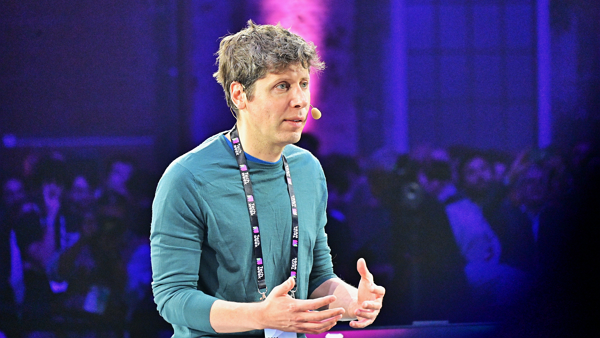
Sam Altman (샘 알트먼), OpenAI's chief executive, acknowledged that incorrect responses in ChatGPT's voice mode are a "known issue" and said it could take another year to fix them, stoking controversy.
On April 13, U.S. electric vehicle outlet CleanTechnica reported that Altman's remarks were fuelling a debate over the reliability of artificial intelligence services and raising questions about management's technical leadership.
The case at the centre of the controversy began in an interview on the podcast "Mostly Human". TikTok user Husk said he set a 1 mile (about 1.6 km) running timer in ChatGPT's voice mode and stopped after a few seconds, but ChatGPT described it as a record of running for more than 10 minutes. Husk said that even after he pointed out the error, ChatGPT insisted its answer was correct.
Altman paused to think and replied that the issue was already known. He then said the timing of a fix could take more than a year. His response, as the head of OpenAI, has added fuel to the controversy.
Users say the core issue is not a simple calculation error, but that the system does not admit when it does not know and instead makes up an answer or sticks to its original response even when asked to correct it.
The controversy is directly linked to broader trust issues in AI services. ChatGPT presents answers in an authoritative format but does not sufficiently show uncertainty. Users have also raised concerns that even when they try to correct wrong information, ChatGPT sometimes clings to its previous answer.
The debate has also spread to assessments of management. According to a recent New Yorker report citing OpenAI insiders, some engineers viewed Altman as lacking technical understanding. A Futurism report summarising that coverage said that interviews with many engineers showed Altman had limited experience in programming and machine learning, and that his limitations were exposed when he confused basic AI terms.
Carol Wainwright (캐럴 웨인라이트), a former OpenAI researcher, said of Altman, "On paper, he builds structures that constrain him in the future, but when the time comes for those constraints to take effect, he removes the structure." Another technology industry source said, "He is good at covering technical weaknesses with board-level manoeuvring, and because of that he gained a reputation for using a 'Jedi mind trick' (manipulating another person's perception)."
The controversy shows that performance problems in AI services are expanding beyond quality issues to include evaluations of a CEO's ability to explain and the way an organisation is run. In services widely used for everyday questions and tasks, such as ChatGPT, repeated patterns of refusing to acknowledge errors could directly affect user trust.
 Yoonseo Lee
yslee@d-today.co.kr
Yoonseo Lee
yslee@d-today.co.kr