
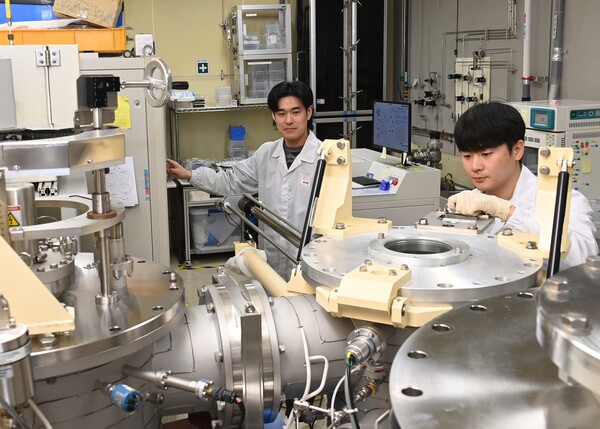
South Korean researchers have presented a new possibility for low-power, high-density memory technology needed for the next era of artificial intelligence (AI).
The Electronics and Telecommunications Research Institute (ETRI) said on Monday it has demonstrated a next-generation DRAM structure that can store data stably without a separate capacitor.
The researchers developed a '2T0C (2-Transistor-0-Capacitor)' DRAM structure using oxide semiconductor transistors (TFTs) for displays. It is a next-generation memory approach known as 'capacitorless DRAM'. ETRI said it points to a new direction for memory technology in the era of AI and data-centric computing.
According to ETRI, conventional DRAM uses a '1T1C' structure with 1 transistor and 1 capacitor, with the capacitor storing charge. Most commercial DRAM currently uses the 1T1C structure. But as semiconductors shrink, it becomes difficult to implement capacitors, and process complexity and power consumption increase.
The researchers focused on an oxide semiconductor with low leakage current and strong charge retention. They applied indium-tin-zinc oxide (ITZO) with added aluminium and precisely controlled internal device defects through a nitrous oxide (N2O) plasma process to suppress leakage current. They also optimized the channel ratio (W/L) of the read transistor to keep stored charge from disappearing easily.
As a result, the device was able to retain data for more than 1,000 seconds. The memory window, the range that clearly distinguishes data as '0' and '1', improved by about 13 times. This means data can be stored for longer and more accurately.
Soo-ji Nam (남수지), a principal researcher at ETRI's Flexible Electronic Devices Research Lab, said, "We confirmed that oxide semiconductor technology that has advanced in the display field can also be applied to next-generation memory devices." She added, "It is expected to play an important role in implementing 3D semiconductor integration technology and low-power computing systems in the future."
A master's student at the UST campus at ETRI participated in the research as first author. The work was carried out with support from the Ministry of Trade, Industry and Energy's 'Inorganic Light-Emitting Display Technology Development Project' and the 'ETRI New Concept Advanced Research Project'.
 Jin-ho Lee
jhlee26@d-today.co.kr
Jin-ho Lee
jhlee26@d-today.co.kr