
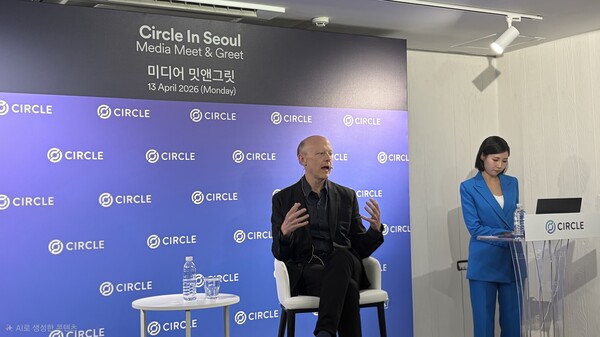
U.S. stablecoin company Circle has rated South Korea as a key hub in the global digital asset market and has formalised the possibility of expanding its business in line with domestic regulatory developments. Circle said it would focus on technical cooperation and providing infrastructure with local financial firms, exchanges and fintech companies.
Circle co-founder and CEO Jeremy Allaire (제레미 알레어) said at a press briefing held in Seoul on April 13 that South Korea is one of the most dynamic stablecoin markets in the world. He said he is closely watching South Korean government discussions on legislation related to digital assets and stablecoins.
He said the South Korean government is showing moves to incorporate into制度 a basis for private sector-led issuance of a won digital currency. He said such changes could be a chance to bring South Korea into a new internet financial system.
Allaire also explained Circle's vision. He said Circle has grown USDC and its stablecoin network over the past decade with the goal of building an internet-based financial system. He said programmable money, blockchain networks and artificial intelligence-based economic activity are now converging, and the foundation of the digital economy is forming rapidly.
He said Circle is entering the global financial system centred on a regulated stablecoin network. He said governments and policymakers in each country are also working to bring it into the formal system.
Circle's high assessment of the South Korean market is based on an already established digital asset base. Allaire said South Korea has a large population participating in digital assets, is often cited as a top-tier global market, and is a country with companies active in blockchain technology and high technology acceptance.
He said that if the rule of law and institutional foundations are added, South Korea could grow into one of the most mature markets by global standards.
Asked how Circle would do business in South Korea, he said the company is reviewing a local business structure suitable for Circle. He said if a legal path is created that allows foreign-issued stablecoin operators to enter the domestic market, Circle would very seriously assess ways to operate formally in South Korea under regulation.
He said Circle has set up registration and operating systems when rules opened in major markets including Hong Kong, Singapore, Japan, the United Arab Emirates and Europe. He said it views South Korea by the same standard.
He took a more cautious stance on a won stablecoin strategy. Allaire said the possibility of Circle issuing a won stablecoin directly is low. He said South Korea's future制度 is likely to be designed around consortia led by South Korean banks and local fintech and digital asset companies.
Because Circle is not a South Korean bank, he said it is more realistic to cooperate with local operators preparing to issue won stablecoins rather than become an issuer itself.
Allaire introduced the blockchain network ARC, which Circle is pushing to commercialise this year, and the stablecoin-based payments network CPN. He said cooperation is possible in South Korea across areas including cross-border payments, overseas remittances, foreign exchange and issuance of tokenised assets.
He said some South Korean companies are in talks with Circle on cross-border payments and international fund transfers. He also mentioned a won-based project called KRW1 that is in test issuance on ARC.
Cooperation with local exchanges is also taking shape. Allaire said Circle is pushing to expand partnerships with major South Korean exchanges including Upbit and Bithumb, and signed cooperation agreements with the two companies on the day.
He said the cooperation includes not only spreading USDC within local exchanges but also expanding collaboration into other technology areas Circle holds.
Circle is also broadening touchpoints with the financial sector. Allaire said South Korean financial firms, like financial institutions around the world, are showing high interest in improving cross-border payments using stablecoins, the structure for issuing won stablecoins, and related technical infrastructure.
He said asset tokenisation, such as tokenised bonds and tokenised credit products, is also an area South Korean financial institutions could focus on. He said Circle is building a general-purpose infrastructure that can support both banks and non-banks.
He also confirmed contact with regulators. Allaire said Circle is in constant communication with policy and financial authorities in major countries and met South Korean regulators on the day. He declined to comment on the details of the discussions.
Circle also left open the possibility of direct investment in South Korean companies. Circle has invested in about 150 startups so far through its venture investment unit.
Allaire said Circle is not a specialised venture capital firm. He said if there are promising projects in South Korea that can promote adoption of its technology and develop the internet financial system, Circle will consider small investments together with other professional investors.
 Oh Sang-yup
yub@d-today.co.kr
Oh Sang-yup
yub@d-today.co.kr