
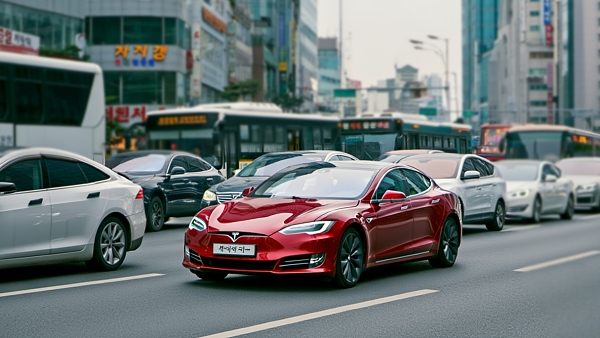
Automakers are rapidly expanding monthly subscription sales of driver-assistance functions. The strategy aims to generate recurring revenue through software after a vehicle is sold.
InsideEVs reported on April 9 that the key is charging for partial self-driving features. Tesla offers an FSD subscription service for $99 a month, and Rivian recently introduced a $49.99 monthly plan. General Motors' Super Cruise costs $20 to $40 a month after a free trial, and Ford's BlueCruise is offered for $49.99 a month. Lucid Motors is also preparing a subscription model at about $69 a month and said it could expand to as much as $199 a month depending on the features.
Automakers are backing the model because it allows them to keep generating revenue after delivery. They are seeking monthly income by unlocking software functions, moving away from a structure centered on vehicle sales and after-sales maintenance. Lucid has presented autonomous-driving subscriptions as its biggest software monetisation opportunity and sees them contributing to improved profitability and cash flow over the long term.
The issue is consumer response. Critics say fatigue is growing over having to pay an additional subscription fee after already paying a large amount to buy a vehicle. Market research firm J.D. Power analysed that in-car subscription services tend not to be preferred overall. Some assessments also say that at the current level of technology, hands-free driving functions do not provide sufficient value for the price.
The automaking industry has faced backlash multiple times while charging for functions. BMW drew criticism after offering heated seats as a subscription in some markets, and Mercedes-Benz was also embroiled in controversy over charging for performance functions. By contrast, Lincoln chose a strategy of avoiding subscriptions in some models.
Limits in many features sold today are also clear. Functions offered by major companies such as Tesla, Rivian and Lucid mostly remain at Level 2 driver assistance. Even if the vehicle supports steering and acceleration or braking to some extent, the driver has final responsibility. That is why criticism emerges that consumers do not feel sufficient value even if the industry tries to collect a monthly fee.
Even so, the market is not nonexistent. GM said it generated about $235 million in revenue from Super Cruise subscriptions in 2025 and had 620,000 subscribers. The company expects that revenue to rise to $400 million in 2026. It suggests some consumers are still willing to pay for convenience.
Amid this trend, the industry's focus is turning to Level 3 and higher autonomous driving. It is concentrated there. Ford and GM have signalled plans to introduce functions in the near future that reduce the burden on the driver's gaze, and Lucid Motors set a goal of achieving full self-driving (Level 4) by 2029.
Automakers see consumers paying monthly subscription fees more actively if autonomous driving is implemented at a level that allows them to take their hands off the steering wheel, look away from the road and reduce the burden of responsibility. For now, the dominant view is that it is a transitional period in which the technology level and consumers' willingness to pay do not align.
 Jinju Hong
hongjj@d-today.co.kr
Jinju Hong
hongjj@d-today.co.kr