
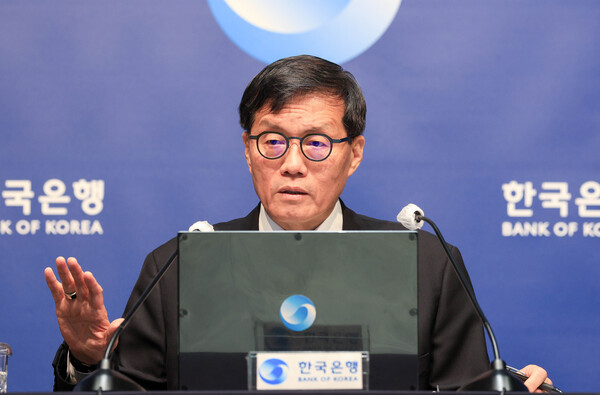
The Bank of Korea held its base rate at 2.50 percent. Governor Lee Chang-yong (이창용) said that with uncertainty from the war in the Middle East rapidly increasing, the bank decided to watch how the situation unfolds rather than hasten a decision on the direction of monetary policy.
At a press conference after the Monetary Policy Board meeting on April 10, Lee said upward pressure on inflation and downward pressure on growth were rising at the same time due to the war in the Middle East, while volatility in financial and foreign exchange markets had increased. He said it was appropriate to maintain the current policy rate level while checking the spillover effects.
Inflationary pressure is also increasing. Consumer prices rose 2.2 percent in March, and inflation was projected to climb to the mid-to-upper 2 percent range in the period ahead due to the impact of international oil prices.
Lee said this year’s inflation rate could exceed the previous forecast of 2.2 percent by a considerable margin.
He played down the possibility of a rate hike raised by some in the market. For now, he said, the impact of the Middle East situation on economic variables is much bigger than the interest rate policy itself.
Lee said in recent weeks economic variables have been fluctuating sharply depending on news from the Middle East rather than rate policy. He said it was not a time to seriously discuss rate hikes or cuts.
He added that it is difficult to mechanically say at what level of inflation expectations or prices the bank would respond with rates. He said the bank must comprehensively judge the persistence of the shock and whether there are secondary spillover effects.
Stagflation risk hard to rule out
He did not rule out the possibility of stagflation if the Middle East situation becomes prolonged. He said the likelihood is not high at this point.
Lee said if the current situation ends, the possibility of stagflation is not high. But he said it would be difficult to deny that possibility if the shock becomes prolonged due to factors such as the destruction of energy infrastructure.
He said the Middle East situation is expected to be the biggest variable for the economic outlook. Lee stressed that whether the war continues and whether energy infrastructure is damaged are important enough to outweigh other factors.
On fiscal policy, he gave a positive assessment of the supplementary budget.
Lee said the supplementary budget has a positive aspect in that it uses excess tax revenue as funding rather than debt. He said it could play a role in responding to the economy to some extent at a time when downside risks to growth are large.
The Bank of Korea plans to maintain a data-driven response stance for the time being. Lee said future monetary policy would be decided by judging the size and persistence of the impact on inflation and growth based on additional information related to the Middle East war and economic indicators.
He made clear that the rate path is also likely to be heavily influenced by how the Middle East situation develops.
Lee, who attended what was his last Monetary Policy Board meeting ahead of his departure on the day, answered reporters’ questions about his monetary policy record during his term. He said that on rate decisions, board members did a good job, and while it may sound like boasting, he has no regrets. He said he thinks he has done well.
 Ji-young Lee
ljy@d-today.co.kr
Ji-young Lee
ljy@d-today.co.kr