
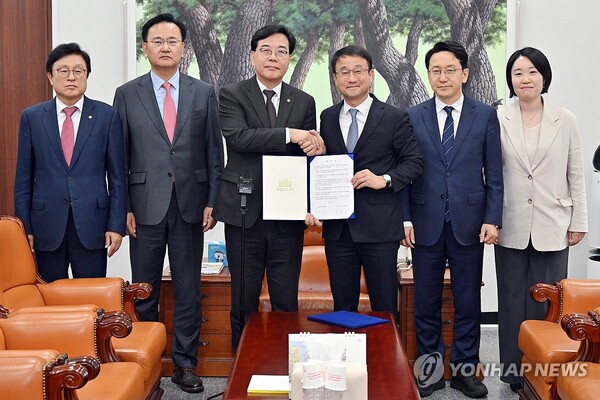
The ruling and opposition parties agreed on April 10 to keep the total size of the supplementary budget proposed by the government at 26.2 trillion won while increasing and cutting some projects.
They decided to maintain the government plan for budget spending related to payments of up to 600,000 won to the bottom 70 percent by income among all citizens, a key issue in the extra budget bill under the high oil price relief programme.
The Democratic Party and the People Power Party agreed on the measure in a meeting at the National Assembly on the deadline day for processing the extra budget, the parties' floor leaders told reporters.
According to the agreement, the parties decided to keep the total size of the extra budget at the government proposal of 26.2 trillion won.
That means some projects were increased or cut during negotiations, but the overall total did not change.
Specifically, the parties agreed to add 100 billion won in budget spending to temporarily offer a 50 percent discount for K-Pass, a public transport fare refund service.
They also agreed to increase spending by 200 billion won for support items aimed at stabilising naphtha supply and demand.
The government proposal includes support for differences in naphtha import unit prices, and the plan is to increase related spending to expand the support period, volume and targets.
They also agreed to add 200 billion won to introduce a fuel price-linked subsidy for agricultural machinery, raise fuel price-linked subsidies for tax-free diesel for farmers and fishers, ease fuel cost burdens for coastal passenger ferries and expand support for inorganic fertiliser.
They also agreed to revise the government's enforcement decree under the Passenger Transport Service Act so that charter buses can also receive temporary fuel price-linked subsidies.
For the high oil price relief programme, they decided to maintain the government's original plan.
If the supplementary budget passes, 32,560,000 people in the bottom 70 percent by income will receive support ranging from a minimum of 100,000 won to a maximum of 600,000 won per person.
For a "tourism product linked to chartered flights from China to local areas in South Korea," which the People Power Party strongly criticised during a comprehensive policy questioning session of the Special Committee on Budget and Accounts, the parties agreed to reflect it with some adjustments to the business details.
Those attending the meeting included Democratic Party floor leader Han Byung-do (한병도) and floor deputy chief whip Cheon Jun-ho (천준호), People Power Party floor leader Song Eon-seok (송언석) and floor deputy chief whip Yoo Sang-beom (유상범), and lawmakers including Lee So-young (이소영) of the Democratic Party and Park Hyeong-su (박형수) of the People Power Party, who serve as secretaries of the National Assembly Special Committee on Budget and Accounts.
The ruling and opposition parties plan to hold a late-night plenary session and vote on the extra budget bill on April 10.
Lawmaker Lee So-young (이소영) told reporters, "We have reached an agreement in broad terms," adding, "There will be very technical numerical adjustments (until before the plenary session)."
[Yonhap News Agency]
 Online Team
d-today@d-today.co.kr
Online Team
d-today@d-today.co.kr