
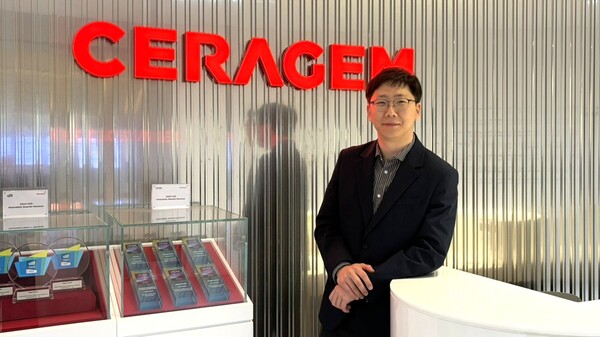
Ceragem, a medical device manufacturer with 28 years of operations, is accelerating its AI transformation (AX). It is focusing on enabling devices to detect physical conditions in real time and respond immediately.
Jun-yong Park (박준용), head of Ceragem's AX Center, said in an interview with DigitalToday that the company is first considering an edge AI structure for functions where real-time performance is important, and is setting design directions so sensitive data can be processed initially on the device. Edge AI processes AI computations on the device itself without going through cloud servers. The plan aims to secure both response speed and data protection.
Ceragem's push for AI transformation is based on an “AI wellness home” strategy. It views the home as a health management platform and has incorporated AI. The AX Center, the organisation executing the shift, was launched in the second half of 2025. Park said that for health-management habits to continue in daily life, the home was the key space, and that the company is applying AI technology to understand users' conditions and provide services suited to each situation.
It differs from software AI in that the device acts directly on the body. Park said the key is to implement a structure where, beyond simply analysing data, condition recognition and corresponding management take place together. He explained that AI-applied products provide needed healthcare solutions based on the user's physical condition and operate in an integrated form combining multiple functions.
A representative concept is the “Master AI Multi Therapy Pod” unveiled at CES 2026. Based on spinal care, it combines more than 10 functions including LED skin care, heat and electrical muscle stimulation (EMS) to create a management programme tailored to the user's condition. It is at a pre-commercialisation stage, but external assessments are positive. Ceragem's CES Innovation Awards rose for three straight years, doubling to 3 in 2024, 6 in 2025 and 12 in 2026.
Because it is a medical device, safety design against AI misjudgments is crucial. Park said the company plans to define safety-related functions by stage and consider zone-by-zone execution authority, such as “consent first, then proceed,” “strict control” and “notify, then wait.” On how AI intervenes, he said the company aims for a customer experience in which it appears only when needed rather than intervening at all times. He also stressed the principle that sufficient verification in line with relevant standards must come first before commercialisation.
Setting boundaries with medical practice is a sensitive issue when AI analyses biometric data such as sleep, blood pressure and blood sugar. Park said the company is approaching areas that could be interpreted as medical judgement or diagnosis with caution, based on relevant standards and legal review, and that at this stage it is reviewing matters with a focus on wellness and user experience.
Data accumulated in experience spaces is also used to advance technology. The touchpoint is “Ceragem Wellaunge,” which it operates nationwide. In operating Ceracheck 1.0, the company confirmed customer needs and expanded mental measurement items from 9 to 15, and upgraded to Ceracheck 2.0 by adding 32 new items including learning capability, cognitive function and psychological tests. It is also preparing an integrated platform to extend measurement experiences that were only possible in stores to the home.
A “healthcare alliance” to secure external technology is also under way. After signing its first MOUs with 5 AI and healthcare companies in October last year, Ceragem signed additional agreements in March this year with 4 companies including Deepmedi, an AI-based digital biomarker analysis company, and Soldoc, a non-face-to-face treatment company. On data security, it is maintaining ISMS-P certification and plans to pursue cooperation with external security companies if needed.
The AX Center's role is separated from the product R&D organisation. The AX Center connects AI technology and data from a platform perspective to design and build direction across products and services, while the product R&D organisation handles individual product function implementation and quality. Park said the AX Center will go beyond introducing AI technology to serve as a key organisation that leads execution from establishing governance.
 Seulgi Son
sageson@d-today.co.kr
Seulgi Son
sageson@d-today.co.kr