
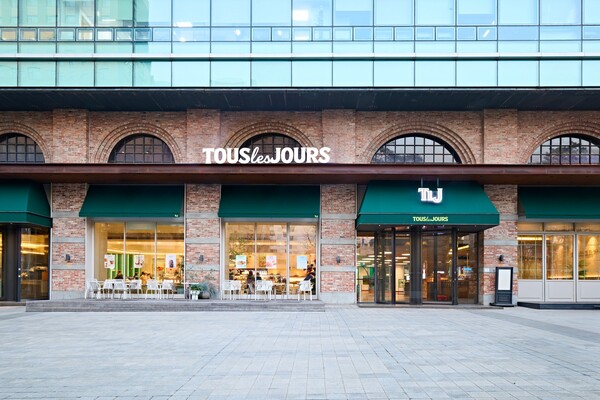
CJ Foodville returned to the "1 trillion won club" last year as annual sales topped 1 trillion won for the first time in 7 years. The rebound is seen as stemming from a reshaped portfolio focused on reorganising its domestic business and expanding its overseas bakery operations. This year it is expected to keep growing overseas while putting more weight on quality growth at home.
CJ Foodville posted 1.0208 trillion won in consolidated revenue last year. That was up about 12 percent from a year earlier. Operating profit fell 9.9 percent over the same period to 50.1 billion won. Preparations to start up a U.S. plant, investment in global infrastructure and expanded local hiring, as well as higher costs for sourcing raw materials at home and abroad, are seen as factors.
The results are notable in that they are seen as the outcome of a business portfolio overhaul rather than a simple rebound in scale. CJ Foodville set up Twosome Place in 2018 by spinning off its coffee business unit, expanding its scale, but later struggled through the COVID-19 pandemic and other factors. As the company’s main businesses are the Tous les Jours bakery franchise and its dining operations, the hit was large.
CJ Foodville then sold all of its Twosome Place shares in 2020. It also moved to a strategy of focus and selection, prioritising entry into global markets around its bakery and dining units. As a result, its annual revenue, which fell from 1.3716 trillion won in 2018 to 608.8 billion won in 2021, rose steadily to 759.8 billion won in 2022, 844.6 billion won in 2023 and 909.2 billion won in 2024, before topping 1 trillion won again last year at 1.0208 trillion won.
Store numbers followed a similar path to the annual revenue chart. The number of CJ Foodville stores fell to 1,570 by the end of 2021 from 2,566 in the fourth quarter of 2018, as it wound down Twosome Place and took other steps, but rose to 1,698 by the end of last year. The company is seen as having built growth momentum by closing low-profit stores over recent years and reshaping its domestic business around core brands, while accelerating a North America-focused expansion overseas led by Tous les Jours.
North America-led overseas Tous les Jours expansion and investment continues
CJ Foodville expanded its scale through overseas operations in the United States, Vietnam and Indonesia. Its overseas business is centred on the Tous les Jours-led bakery business, and it focused on localisation including steadily increasing the number of stores in the United States.
The number of overseas stores also shows a pattern similar to overall sales. As of the fourth quarter of last year, CJ Foodville had 345 overseas stores. That was down from 380 in the fourth quarter of 2018 to below 200 during the COVID-19 period, before recovering to 209 in the fourth quarter of 2022, 223 in the fourth quarter of 2023 and 286 in the fourth quarter of 2024, and approaching levels seen 7 years ago by the end of last year.
The U.S. bakery business in particular is seen as driving growth. CJ Foodville has continued opening stores with a mid- to long-term goal of opening 1,000 Tous les Jours stores in North America. The number of U.S. stores increased from 108 at the end of 2023 to 150 at the end of 2024 and 192 at the end of last year, a 77.8 percent rise over 3 years. U.S. unit revenue also rose quickly, growing 283 percent over 5 years from 51.1 billion won in 2021 to 194.6 billion won last year. That is the backdrop for analysis that its overseas local business base has become more solid.
CJ Foodville plans to build a local production system this year centred on its U.S. plant and accelerate store openings to sustain growth. It is strengthening a strategy of expanding scale in global markets with Tous les Jours at the forefront.
Domestic Tous les Jours and dining business to strengthen fundamentals this year
In South Korea, the dining business segment centred on VIPS achieved 12 percent sales growth last year. Revenue from CJ Foodville’s franchise (bakery) and dining segments is split roughly 7 to 3, with bakery accounting for the larger share, but the dining business is also showing growth momentum.
In South Korea, unlike overseas, the company is putting more emphasis on strengthening fundamentals than on aggressive store openings. Its strategy is to refine its store structure and raise operational efficiency by focusing on profitable brands and locations rather than expanding too quickly.
VIPS is pursuing a specialised store strategy and stronger membership programmes based on analysis of commercial districts. The company said the number of VIPS Mania membership users rose 22 percent from a year earlier, showing meaningful customer indicators.
The new dining brand Olly PePe, launched in December last year, positions itself as a casual dining restaurant and is cited as an example of quality growth in its dining brands. It is seen as a new card brought out during a process of reorganising its existing dining portfolio. It is expected to test demand with a concept differentiated from existing Italian restaurant brands and consider expansion around locations where the response is confirmed. At the end of last month, CJ Group Chairman Lee Jae-hyun (이재현) also visited an Olly PePe store.
As CJ Foodville succeeds in restoring its scale, attention is also on the role of CEO Lee Geon-il (이건일). Appointed as CJ Foodville CEO at the end of last year, Lee joined CJ CheilJedang through open recruitment and has served as head of CJ Foodville’s Twosome division and CEO of CJ Foods USA. As he is regarded as having broad experience across domestic and overseas food businesses and the North American market, analysis says he is well suited to lead both CJ Foodville’s U.S.-centred global expansion and the reorganisation of its domestic business.
A CJ Foodville official said, "For the domestic dining business, we want to focus on quality growth with a cautious stance on store-opening decisions, rather than scale growth, under more stable conditions." The official added, "Globally, we will maintain an expansionary stance but focus on expanding scale while considering profitability."
 Shin-hye Ahn
doubletap@d-today.co.kr
Shin-hye Ahn
doubletap@d-today.co.kr