
[DigitalToday reporter Yoonseo Lee] Google has released an artificial intelligence dictation app for iPhone that turns speech into text without an internet connection, and hands-on accounts are drawing attention.
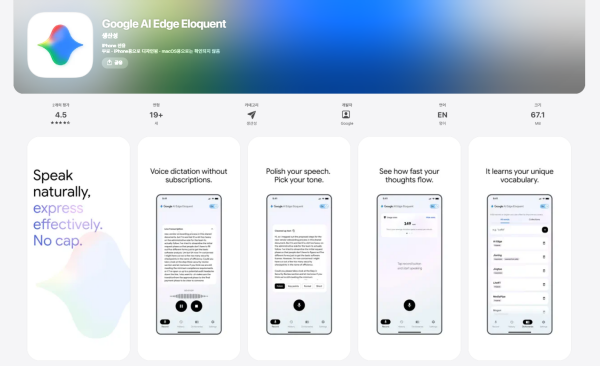
TechRadar reported on April 8 that Google AI Edge Eloquent not only transcribes what users say in real time but also refines it into sentences by trimming verbal habits and unnecessary expressions.
The app runs on Google’s Gemma speech recognition model. It is free, and a key feature is that it can be used offline. Unlike typical voice memo or automatic transcription services that rely on network connections, it provides dictation even without internet access.
Its focus is not a verbatim transcript but producing easy-to-read sentences. It creates text based on what the user actually said while removing common conversational fillers such as “um” and “uh.” A key feature is that it records what was said while clearing out extraneous sounds in casual speech almost in real time.
It also includes personalization features. Users can pull names or frequently used terms from Gmail, and they can add a separate word list.
It also offers a rewriting option to further edit dictation results. It reshapes sentences into formats such as “key points,” “formal,” “shorter” and “longer.”
In actual use, converting voice notes directly into cleaned-up sentences stood out. When a user spoke thoughts into the app while walking, a draft-like transcript appeared first, then about 10 seconds later it was refined into smoother sentences. It was similar to the difference between an auto-generated transcript and an edited transcript, except the editing happened almost simultaneously while the user was speaking.
The sentence rewriting feature focuses on changing tone depending on use. For example, when “key points” was selected, a short memo was compressed into a few bullet points, and applying “formal” turned a personal memo into something like a work sentence. When a short message to confirm a schedule was entered, the app revised it into a more organized email form, adding wording along the lines of, “Even if the schedule changes slightly, I fully understand and can adjust accordingly.”
The app, however, differs in nature from a record-keeping tool that preserves what was said exactly. It naturally corrects incomplete sentences if the meaning comes across and, in some cases, adds missing linking expressions. That is, it is an ideal tool if a perfect record is not needed.
This structure appears to target demand for turning voice memos directly into drafts. It is because users can handle both speaking out ideas and organizing sentences at once rather than writing by hand. By contrast, it may not be suitable for uses such as meeting minutes that must capture every utterance without omission.
The app is currently available for download on the Apple App Store, and supported regions are limited to the United States. Google introduced the app this week without a separate major announcement, and it has begun offering offline AI voice input as a standalone app to iPhone users first.
Go beyond chatbots. Build your next AI agent on your own device. Use #GoogleAIEdge to bring Gemma 4's power to the edge. Experiment in the Gallery app or deploy to any device – laptop, mobile, IoT – via LiteRT-LM. What will you build? Learn how: https://t.co/ThUdBiKw14
 Yoonseo Lee
yslee@d-today.co.kr
Yoonseo Lee
yslee@d-today.co.kr