
As legislation on the Digital Asset Basic Act repeatedly stalls in the National Assembly, the Bank of Korea is stepping up its pilot of a central bank digital currency (CBDC).
The financial sector said on Wednesday that Project Hangang, the Bank of Korea's CBDC pilot, has entered its second phase and is significantly widening its real-world applications. The core of the second phase is to lay the groundwork for commercialising deposit tokens.
After testing online and offline payments at some merchants with 7 banks in the first phase, including KB Kookmin, Woori, Shinhan, Hana, NongHyup, Busan Bank and Industrial Bank of Korea, BNK Kyongnam Bank and iM Bank have newly joined in the second phase.
Payments will be made by QR code at designated online and offline stores, and the places where it can be used are set to expand to convenience stores, supermarkets, coffee shops and bookstores.
The most watched part is a test applying deposit tokens to the disbursement of treasury subsidies. The Bank of Korea will start a test in the first half of this year, in cooperation with the Ministry of Climate, Energy and Environment, to pay subsidies for projects to build electric-vehicle charging infrastructure in the form of deposit tokens.
The use of deposit tokens in public finance disbursement is a world first. LG CNS, the main operator, will continue to run and upgrade the digital currency system in the second phase after the first. LG CNS has also completed development of new features ahead of the second phase, including biometric authentication, person-to-person transfers and automatic deposit-token deposits and withdrawals.
The government has also officially set a direction to expand the scope of CBDC use.
In its 2026 economic growth strategy announced on Jan. 9, it proposed a plan to pay part of treasury funds in deposit tokens from this year in connection with Project Hangang. It also presented a mid- to long-term goal of paying 25 percent of a 700 trillion won budget in deposit tokens by 2030.
The Bank of Korea said it would continue research to allow deposit tokens to be used when trading digital assets such as bonds and stocks. It also said it plans to pursue improvements to laws and institutions needed for commercialising digital currency based on the results of the second phase.
In the first-phase test last year, more than 80,000 citizens and major merchants including Seven-Eleven participated over 3 months. Criticism was raised at the time about effectiveness and convenience.
One official who directly participated in the first-phase pilot said, "I was surprised by the convenience when paying with cryptocurrencies like Ripple in the United States, but the payment method used in the project at the time was no different from the existing complex payment structure," offering a harsh assessment.
The criticism is that it is not an innovative simple payment method, but merely adds one more payment option based on deposits.
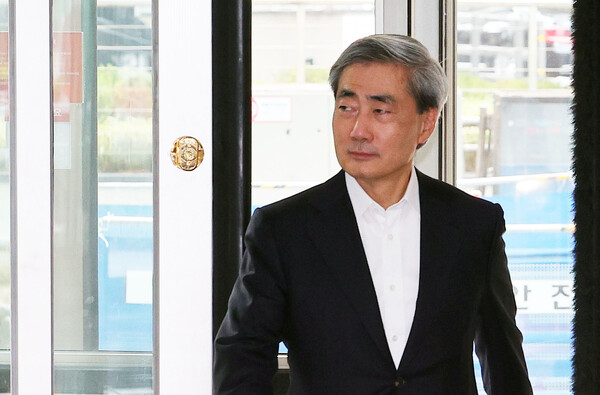
Shin Hyun-song (신현송), the new Bank of Korea governor set to officially take office at the end of this month, is signalling a much tougher CBDC-centered stance than Governor Rhee Chang-yong.
Shin, who previously worked at the Bank for International Settlements (BIS), publicly laid out a stance of keeping stablecoins in check at the World Congress of Economists (ESWC) held at COEX in Seoul in August last year.
He criticised stablecoins for causing a silo phenomenon that undermines the singleness of money.
He also pointed out that stablecoins account for 63 percent of digital asset crime, warning that anonymous trading via blockchain personal wallets could be abused as a means of capital outflow and a way to circumvent financial crime.
At the event, Shin stressed the need for an integrated platform managed by central banks, directly citing Project Hangang and the BIS global cooperation project, Project Agora.
A struggle for initiative between the Bank of Korea and the Financial Services Commission has also surfaced over authority to regulate digital assets.
Current bills specify that the Financial Services Commission has authority to approve stablecoin issuance, but the Bank of Korea is emphasising its role in the approval process on the grounds that stablecoins issued by non-bank entities could weaken the transmission of monetary policy.
As long as the Digital Asset Basic Act is delayed, the Bank of Korea's lead on the CBDC becomes more entrenched. The direction of the won-based digital currency ecosystem is expected to depend on how the National Assembly's Political Affairs Committee legislation subcommittee handles the bill on the 15th.
Kim Ji-won (김지원), an analyst at KB Securities, said, "With the appointment of Shin Hyun-song as the new governor, who has led CBDC research, stability from the perspective of 'singleness of money' is more likely to be emphasised, making it an important variable for domestic stablecoin legislation and the direction of CBDC design."
 Oh Sang-yup
yub@d-today.co.kr
Oh Sang-yup
yub@d-today.co.kr