
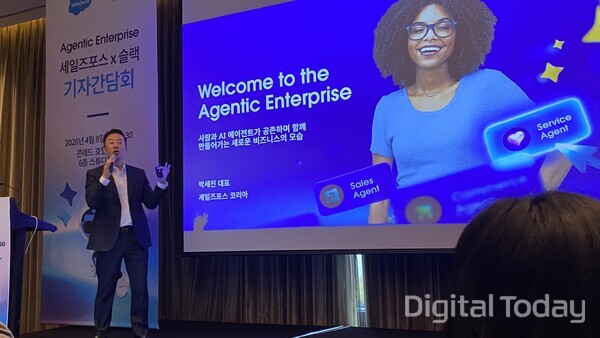
[DigitalToday reporter Seul-gi Son] "Agent AI is not simply the next generation of AI. It is a completely new technology paradigm that stands in for people, makes judgments and carries out execution."
Global customer relationship management (CRM) company Salesforce is moving to shift its enterprise collaboration platform Slack into an AI agent-based work operating system, or agentic work OS. Salesforce Korea CEO Se-jin Park (박세진) said at a press briefing in Seoul's Yeouido on April 8 that the goal is an agentic enterprise where people and agents coexist.
The way to implement the agentic work OS is through "Slackbot". Slackbot, formally launched in January, is a personal AI agent built into Slack by default. It summarises and records meeting content automatically, draws out action items and automates repetitive tasks. It can be used immediately by activating Slack without separate installation or setup.
Slackbot's distinguishing feature is that it can go beyond simple answers and execute actual work. It directly processes system transactions, such as classifying customer complaints (VOC) by type or changing case statuses in bulk with a single natural-language line. It is also expected to be given the role of a "super agent" that coordinates all agents within Slack in the future.
Slackbot is seen as highly usable thanks to Slack's open platform structure. External AI agents such as Claude and ChatGPT, as well as other companies' work tools such as Jira and Confluence, can be called within Slack. Tasks such as approval sign-offs and deployment execution can be handled within Slack without switching apps. More than 2,600 apps are currently integrated with Slack.
The problem this structure aims to solve is "screen and app switching (context switching)". Go-jung Kim (김고중), head of business at Slack Korea, said context switching between different applications reduces employee productivity by about 40 percent. He said people and agents can collaborate to carry out all work in one place.
South Korean companies also praised the ability to work without switching. Ye-chan Lee (이예찬), a software engineer at Danggeun Market, said all business flows such as incident alerts, data reports and decision history are being brought together through Slack alone. He said deployments can be done immediately by pressing a button when an alert arrives in Slack, and a work ticket is created right away by adding a single emoji to a conversation. He said Slack is becoming the most powerful work OS for developers.
Cheong-gyu Lee (이청규), an engineer at Woowa Brothers, said greater connectivity between Jira, Confluence and Slack has removed the need to go back and forth between existing systems. He said permission requests or approval procedures for internal systems, as well as external software-as-a-service (SaaS) systems, have also come to be handled in Slack alone. He said context switching, which felt the most tiring, has been greatly reduced.
Early results from Slackbot adoption were also disclosed. Salesforce said productivity increased by up to 4.8 times and the speed of task completion improved by 25 percent after adopting Slackbot. Revenue per employee rose by up to 3 times. By Salesforce's internal standard, weekly work efficiency improved by up to 20 hours per team and generated more than $6.4 million, or about 9.5 billion won, in internal productivity value. Salesforce said Slackbot is recording the fastest adoption pace in the company's history just 2 months after launch.
Growth is also appearing across the Slack platform overall. AI-supported Slack apps grew 690 percent from a year earlier. Slack is now sending 5 billion messages per week and running 3 million workflows daily.
As Slack declares an agentic work OS, attention is also on its competitive landscape with Microsoft Teams. Across the software industry, efforts are continuing to attach AI agents to companies' own collaboration tools. Park said it is a complementary relationship rather than a competition with Teams. He said many companies split their use, using Teams for video conferencing and Slack for work execution, and using both tools in parallel is common among IT companies.
 Seul-gi Son
sageson@d-today.co.kr
Seul-gi Son
sageson@d-today.co.kr