
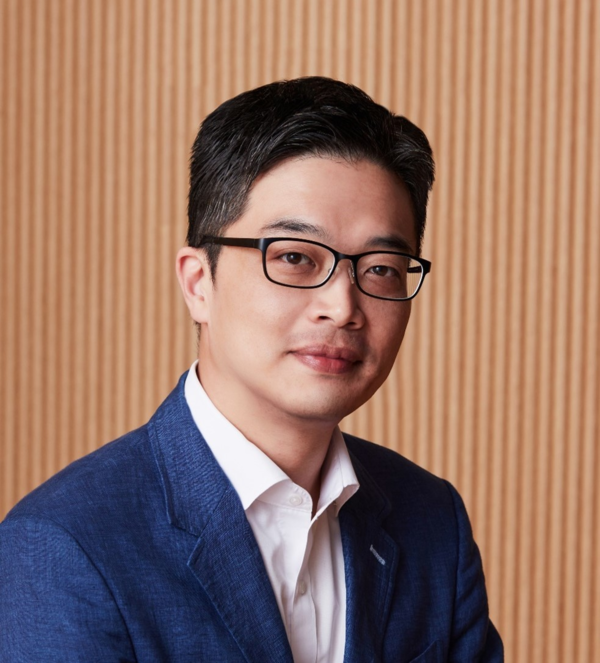
[DigitalToday Jin-ho Lee] South Korea's Ministry of Science and ICT and the National Research Foundation of Korea selected Sim Woo-young (심우영), a professor in Yonsei University's Department of Materials Science and Engineering, as the April winner of the Republic of Korea Science and Technology Award.
The award selects 1 researcher each month who has produced original research achievements over the past 3 years and made a major contribution to the development of science and technology. It presents the ministry's deputy prime minister's award and prize money of 10,000,000 won.
To mark April, which includes Science and ICT Day, the ministry and the foundation selected Sim as the winner for developing a new-structure III-V semiconductor material that does not exist in nature. III-V semiconductors are compound semiconductors made by combining group 3 and group 5 elements on the periodic table.
Existing III-V compound semiconductors allow fast electron transport, but offer almost no space for ions to move, limiting the implementation of new electronic functions.
Sim proposed a new semiconductor design concept using a cation-eutaxy structure. Using topochemical etching to selectively remove only some elements, he formed van der Waals gaps that allow ions to move. Van der Waals gaps refer to the average distance maintained when molecules or atoms do not bond strongly and are instead weakly attracted.
Sim demonstrated that the electrical properties and memory functions of a semiconductor can be used at the same time in the new-structure III-V semiconductor material. Compute-in-memory, which can perform memory and computation functions simultaneously in a single material, can significantly reduce the energy consumption needed for artificial intelligence (AI) calculations. It can also mimic synaptic behavior, in which connection strength changes depending on signal strength and timing like the human brain's neural network, raising expectations for use as a neuromorphic AI device.
Sim achieved the results based on support from the Ministry of Science and ICT's Future Materials Discovery Program, which promotes precise material exploration through computational science and experimental synthesis research. The findings were published in the international journal Nature Materials in October 2024. It was also selected as the October issue's research briefing paper of the month.
Sim was also appointed last year as an associate editor of Nano Letters, an American Chemical Society (ACS) journal that is among the most influential in the field of nanoscience, and is contributing to the global academic community.
Sim said it was even more meaningful that South Korean researchers were the first in the world to propose a new semiconductor material that does not exist in nature. He said he wanted to continue challenging research so that South Korea can lead new materials research.
 Jin-ho Lee
jhlee26@d-today.co.kr
Jin-ho Lee
jhlee26@d-today.co.kr