
[Digital Today reporter Dae-geon Seok] The United States and Iran agreed to a two-week truce with 90 minutes left before the negotiating deadline expired. With the likelihood rising that traffic through the Strait of Hormuz will resume, energy supply concerns have eased and South Korean stocks are surging, led by semiconductor shares after they posted record results.
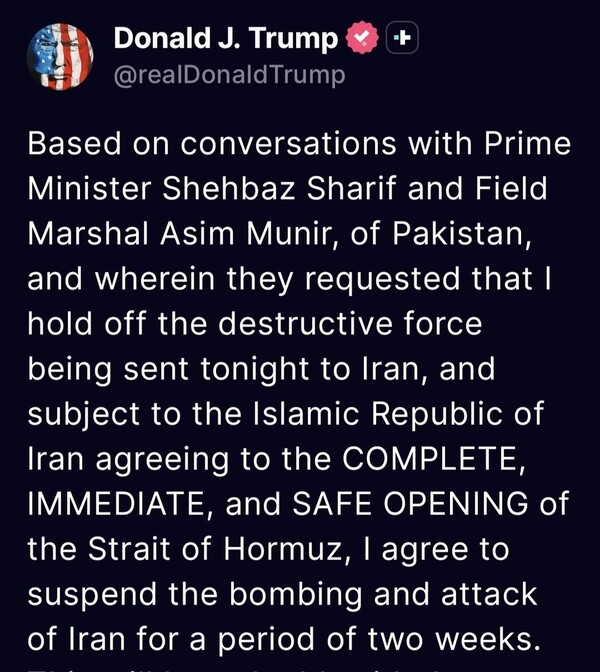
U.S. President Donald Trump (도널드 트럼프) said on April 8 (Korea time) on his social media that he would halt attacks on Iran for 2 weeks on condition that Iran agrees to a full and immediate opening of the Strait of Hormuz. Iran’s Supreme National Security Council also confirmed the truce agreement. Iranian Foreign Minister Abbas Araghchi (압바스 아라그치) said that if attacks stop, Iran will also halt defensive operations and guarantee safe passage through the strait. Mediator Pakistan proposed both a two-week truce and the opening of the strait at the same time, in a setup that has for now avoided escalation.
Financial markets reacted immediately to the truce news. According to the Korea Exchange, the KOSPI had risen above 5,820 as of 11:15 a.m. on April 8. Foreign investors also bought more than 1.2 trillion won net, lifting the index together with institutions.
Samsung Electronics shares are recovering the level referred to as "200,000 won Samsung" and are moving above 210,000 won. SK Hynix also rose about 9 percent to 1,000,000 won, reclaiming the 1,000,000-won level during the session. Samsung Electronics announced preliminary results the previous day of 133 trillion won in first-quarter consolidated revenue and 57.2 trillion won in operating profit. With record results and the truce news combining, buying appears to have spread across the semiconductor sector.
Energy supply concerns have also entered a period of easing. According to the industry, 7 oil tankers linked to South Korean refiners are currently waiting in the Strait of Hormuz, carrying about 14 million barrels of crude. The Ministry of Trade, Industry and Energy said it is checking the specifics of shipping through the Strait of Hormuz through diplomatic channels and will support swift passage for the tankers as soon as details are confirmed.
Still, it is unclear whether a final agreement can be reached within 2 weeks. The two sides will begin full talks on April 10 in Islamabad, Pakistan, but remain far apart on key issues. Iran claimed it included in a 10-point end-of-war proposal items such as allowing uranium enrichment, recognizing control over the Strait of Hormuz and withdrawing U.S. combat troops from the region.
Trump referred to this only as a "negotiable basis," showing a difference in tone, and attention is on the outcome of talks over the next 2 weeks. Even with favorable conditions in the semiconductor industry, if instability in energy supply flares up again, spillover effects across global supply chains and South Korea’s broader manufacturing sector will be unavoidable.
 Dae-geon Seok
d2dg@d-today.co.kr
Dae-geon Seok
d2dg@d-today.co.kr