
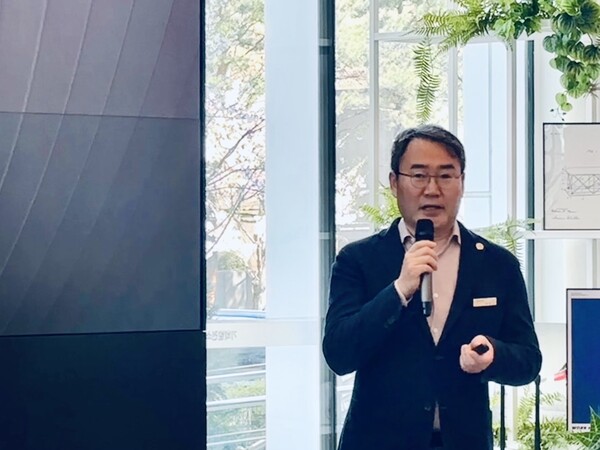
ADTechnology said it will shift from a traditional design house model based on customer drawings and become a first mover that proactively proposes AI server chip architectures. ADTechnology CEO Joon-kyu Park (박준규) said at a press briefing on Monday that the company will move from a passive model of waiting for client requests to an active model of proposing architectures needed for the current paradigm and developing them with customers. The goal is to reach 1.5 trillion won in revenue by 2030.
The company said the shift is driven by structural changes in the design house industry itself. In the past, design houses mainly played a supporting role of adapting circuit data designed by fabless companies to foundry processes. They handled only peripheral design work such as data input and output.
But as semiconductor processes shrink to 5 nm, 3 nm and 2 nm, the number of engineers needed to develop a single chip has increased exponentially, and development costs per project have reached 40 billion to 50 billion won based on 2 nm. That scale is difficult for fabless companies to bear alone. As a result, the role of turnkey partners covering the full process from system architecture design to RTL implementation and mass production is expanding, and the company said it will expand its role accordingly.
ADTechnology is focusing on changes in design demand around CPUs. Park said existing cloud data centres are dominated 80 to 90 percent by Intel and AMD, but a shift is under way to ARM CPU-based systems to improve energy efficiency and cut operating costs required by AI data centres.
Major big tech companies are also developing their own ARM architecture-based server CPUs to improve energy efficiency. While those firms develop large chips optimised for their own cloud services, there are still limited players that can design ARM server CPUs suited to relatively smaller systems such as edge servers or sovereign environments and take them through mass production. ADTechnology said it plans to pre-emptively develop CPU platforms in this niche and propose them to customers.
ADTechnology cited its collaboration experience with the two leading global foundries as the basis for making the shift. Since its establishment in 2002, it has carried out more than 860 design projects and obtained TSMC's official design partnership DCA (Design Center Alliance) and the higher-tier partnership VCA (Value Chain Aggregator) qualification. It then switched in 2019 to become a Samsung Foundry design house and has completed more than 170 Samsung Foundry projects, building capabilities in advanced process design.
Park said that after moving from TSMC to Samsung, the company decided how to use Samsung Foundry for customers and came to develop foundation libraries and memory characteristics directly. He said it secured results that were equivalent to or better than benchmarks against the same process at TSMC, and that this was necessary to work with Samsung Foundry. In 2023, it also signed an ARM Total Design partnership, the first in South Korea's semiconductor industry, establishing a foundation to develop server CPU platforms.
Based on its foundry experience and in-house IP development capabilities, the company introduced the 'ADP620', a server CPU platform based on Samsung Electronics' 2 nm process. It has 35 ARM Neoverse V3 cores and uses a CMN-S3 coherent mesh network for inter-core communication. It integrates with an NPU chiplet in a 2.5D method through UCIe 24G/16G die-to-die links and supports (LP)DDR5x memory and PCIe Gen5/6 CXL interfaces. Tape-out is scheduled for the second quarter of 2027.
High value-added orders 26 percent to 73 percent... Advanced-process projects top 70 percent
ADTechnology set a target of reaching 1.5 trillion won by 2030 based on this. On revenue, Park said development costs for a 2 nm project exceed 50 billion won, and running about six projects at the same time would make it possible to generate 300 billion won in development-fee revenue alone. He said server chips in chiplet form have unit prices exceeding $3,000 to $4,000, so 1 trillion won is not such a big number once mass production ramps up.
The shift is already showing up in changes to the order book structure. The share of orders for high value-added projects such as AI, HPC and automotive jumped to 73 percent this year from 26 percent in 2024 and is expected to expand to 84 percent in 2026. The share of orders for advanced-process projects (5 nm or below) also rose to 70 percent from 55 percent over the same period, and the company is targeting 80 percent next year. Overseas order value grew 134 percent from a year earlier, and the revenue share of turnkey projects that run through mass production expanded to 81 percent this year from 60 percent in 2024. Park said the company will evolve into one with a different character rather than simply a design services firm.
 Dae-geon Seok
d2dg@d-today.co.kr
Dae-geon Seok
d2dg@d-today.co.kr