
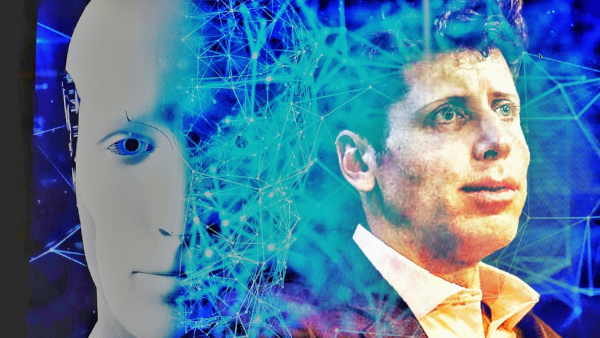
Sam Altman (샘 알트먼), chief executive of OpenAI, urged U.S. policymakers to respond proactively, saying superintelligent artificial intelligence is no longer confined to theory and is rapidly permeating economic activity.
On April 6, blockchain media outlet CoinDesk reported that Altman warned in an interview with Axios that AI can transform productivity while also increasing new risks in cybersecurity and biology.
Altman explained that AI is already performing coding and research tasks that used to be shared among multiple developers. He forecast that future models will support scientific discovery and expand to a level where an individual can carry out team-based work. He stressed: "A programmer in 2026 is working in a completely different way than a year ago."
Cybersecurity was singled out as the area where threats could materialise first. Charles Guillemet (찰스 길레메), chief technology officer at hardware wallet company Ledger, said AI tools are significantly lowering the cost and barriers to entry for finding and exploiting software vulnerabilities. He said reverse engineering and complex vulnerability analysis that used to take months could now become possible in seconds.
CoinDesk reported that in the cryptocurrency industry last year, the value of assets stolen or lost to attacks such as hacks exceeded $1.4 billion. Guillemet warned that the scale of damage could grow, and raised the possibility that new vulnerabilities could be introduced on a large scale as developers rely more on AI-generated code. He stressed the need for mathematically verified code, hardware security that keeps private keys offline, and designs that assume the possibility of system failure.
Altman also pointed to AI's dual nature. He said AI can accelerate innovation in areas such as new drug development and materials science, but can also lower the barriers to entry for more sophisticated cyberattacks and harmful biological research. He said: "The point when a very biology-capable open-source AI model appears is not far off," adding: "Preparing for a situation in which terrorist organisations use it to develop new pathogens is no longer a hypothesis."
Altman also mentioned the possibility that a world-shaking cyberattack could occur within this year, saying large-scale proactive measures are needed to prevent it.
Altman, meanwhile, showed a sceptical stance on the possibility of nationalising OpenAI. While arguing that the United States should develop superintelligence in a way that fits democratic values ahead of competitors, he drew a line, saying cooperation with the private sector matters more than direct government control.
Altman also laid out a view of AI's future structure. He said AI could become a utility like electricity and be built in by default across devices, while the cost of basic intelligence falls but top-tier systems still remain expensive, leading to a polarised structure. He said a "cloud-based personal super assistant" will emerge, and suggested a model in which monthly fees could vary depending on usage.
 Jinju Hong
hongjj@d-today.co.kr
Jinju Hong
hongjj@d-today.co.kr