
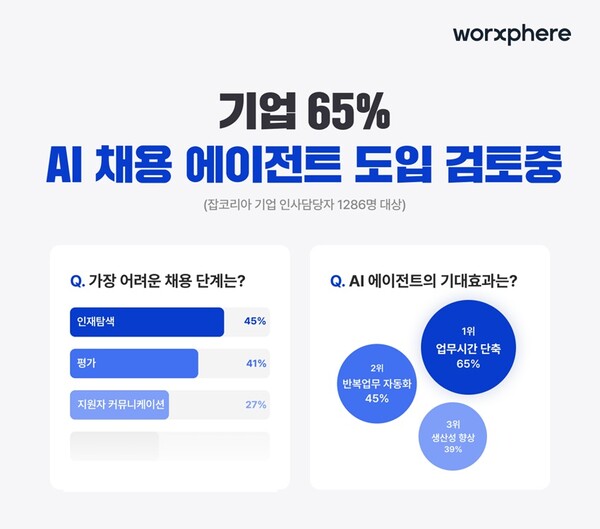
[DigitalToday reporter Chi-gyu Hwang (황치규)] A survey by AI and data-based HR tech platform JobKorea (operated by Worksphere) found many companies are considering adopting artificial intelligence recruiting agents.
JobKorea surveyed 1,286 corporate recruitment officials for about three weeks from Feb. 26 to March 20 on their awareness of introducing and using AI recruiting agents. The results showed more than 65 percent of companies had already applied AI recruiting agents or were reviewing their introduction.
Some 48.8 percent said they were "reviewing adoption" and 13.6 percent said they were "actively reviewing" it. Including those who said they had "already introduced or plan to introduce" them, at 3.1 percent, more than 6 out of 10 companies can be seen as planning to introduce AI recruiting agents into practical work, JobKorea said.
The survey showed the most time- and resource-intensive tasks in recruitment were "searching and sourcing suitable talent," cited by 44.5 percent of respondents, multiple answers allowed. It was followed by "reviewing and evaluating applicants," at 41.0 percent. Respondents also reported burdens across operational tasks, including applicant communication at 27.0 percent, writing job postings at 26.8 percent and coordinating interview schedules at 26.6 percent.
Pain points were linked to functions respondents expect from AI agents. The most cited task they wanted AI to assist with or perform was "recommending talent suited to the role," at 39.7 percent. It was followed by automatic writing and optimisation of job postings at 30.6 percent, candidate matching and recommendations at 27.5 percent, and secretary-type support across recruitment work at 27.0 percent. The results confirm demand for "recommendation-based AI" that quickly finds and recommends suitable talent, beyond automating simple repetitive tasks.
The expected effect from adopting AI agents was ultimately interpreted as "improving the efficiency of recruitment work." Respondents said they expect shorter time spent on recruitment tasks at 64.9 percent, automation of repetitive tasks at 44.8 percent and improved productivity at 39.0 percent, JobKorea said.
 Chi-gyu Hwang
delight@d-today.co.kr
Chi-gyu Hwang
delight@d-today.co.kr