
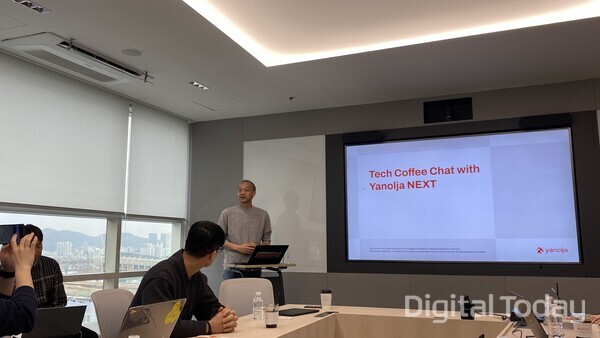
[DigitalToday reporter Seulgi Son] Yanolja Next, the technology R&D subsidiary of travel tech company Yanolja, held a demo event on Monday at MDM Tower in Seoul's Gangnam district and unveiled three in-house artificial intelligence solutions. It was the first time it had 공개ed solution demos since its launch a little more than a year ago. The company introduced, in order, Tella, a voice reservation-confirmation AI agent; Vicker AI, a lodging image-generation AI; and EEVE ROSETTA, a travel-focused translation model.
Yanolja Next is an independent corporation established in January 2025 to provide shared technology to Yanolja Group's enterprise solutions and consumer platform. More than 90 percent of its workforce are engineers.
Jang Jung-sik (장정식), CEO of Yanolja Next, said the past year was a period of building the technology stack and verifying it internally. He stressed that AI is a means and that its work ultimately is to solve problems in the travel industry through technology. He said it would focus this year on expanding the scope of real-world application and was reviewing plans to supply solutions to outside companies as early as within this year or from early next year.
The most noted solution at the event was Vicker. When a user uploads a single lodging photo, the AI analyses the space structure and automatically generates images for different seasons and times of day, including spring, summer, autumn and winter, and daytime, sunset and night views. It is not a simple filter or style conversion, but a method that keeps the building structure and internal flow intact while changing only environmental elements such as the sky, trees and lighting. It also has a function to convert still images into time-lapse videos.
Korean, a Yanolja Next IAB platform solution leader, said a long-standing challenge for lodging platforms was the mismatch of time and space, in which summer photos must convince winter travellers. He said the company approached it not by taking more photos but by expanding from a single image. He said the idea started from the burden on operators, as summer photo shoots alone can cost 3,000,000 to 4,000,000 won for a pension, and shooting by season and time zone can run into tens of millions of won.
It completed a beta rollout in the third quarter of last year for about 80 pension properties listed on the NOL platform and plans to expand adoption within this year. A leader said when it first posted a call for participating operators, the application window was planned for 3 days but closed in 1 hour, conveying interest.
Vicker was jointly developed by Yanolja Next and Google Cloud on the image pipeline through a technical cooperation programme. Jang said the structure chains dozens of models in stages to produce a single image. He said multiple preprocessing steps such as upscaling, downscaling, image expansion and tone standardisation are needed to minimise hallucinations even in mass processing.
Yanolja Next is also developing a "room tour" function for Vicker. The AI analyses multiple room photos to reconstruct movement paths in the space so users can experience it as if moving through the room, rather than flipping through pictures. It is not yet in the adoption stage, but a prototype-level demonstration was conducted.
Tella is a solution in which an AI voice agent makes reservation-confirmation calls between travel agencies and hotels and reflects the call content in real time in the system. At the event, the company demonstrated a multilingual real-time switching feature in which, when a call is made in English, the AI immediately recognises a response in Korean and continues the conversation.
It is currently applied to the India operations team of Stuba under Yanolja Go Global (YGG), a Yanolja affiliate, and is operating in live service for hotels in about 37 countries. Jang said Asian hotels show no resistance even if they are told it is AI, but some hotels in Europe hang up the moment the word AI is mentioned. He said the company is customising by region, language and culture.
Jung Woo-jin (정우진), a Yanolja Next IAB platform leader in charge of Tella development, said response accuracy is above 97 percent in real operating environments, excluding policy-related refusal factors by hotels. He said the actual automation rate can vary depending on unexpected human reactions, so it continues to expand scenarios. It plans to expand beyond reservation confirmation to an "on-call" function that automatically calls the person in charge in an emergency.
EEVE ROSETTA is a travel and lodging domain-focused large language model for translation that supports 32 languages. A key feature is translating while preserving data structures such as JSON and XML, and it is released as open source on Hugging Face. On BLEU translation accuracy, the 27B model recorded 17.64, the highest among comparison models, and sentence fluency (ChrF) was 37.21, ranking first in the entire comparison group. The company said a lightweight 7B model also ranked first among comparable models in both BLEU and ChrF.
It is currently being applied to translation of overseas distribution content for domestic lodgings on the NOL platform and translation of hotel information supplied overseas. A leader said having its own model reduces reliance on external APIs and is saving hundreds of millions of won annually. He said the lightweight model maintains performance at the level of large models, making it usable in environments without internet access or for companies where security is important.
Yanolja Next said it is aiming to build a technology platform for the travel industry overall rather than sell individual solutions. Jang said the ultimate goal is to equip the technology stack needed across the travel value chain, from PMS to wholesalers and OTAs, and provide an automated platform service requiring less human handling.
While Yanolja Group affiliates are currently its main supply target, Jang said it is reviewing plans to supply solutions to companies outside the group as early as within this year and no later than early next year. It is considering various monetisation models such as software-as-a-service subscriptions, API usage and transaction-linked types, and some solutions are being tested step by step for paid conversion through pilot deployments. The company said operating as a separate corporation is aimed at securing mid-to-long-term technological competitiveness and creating an independent R&D environment rather than short-term revenue.
 Seulgi Son
sageson@d-today.co.kr
Seulgi Son
sageson@d-today.co.kr