
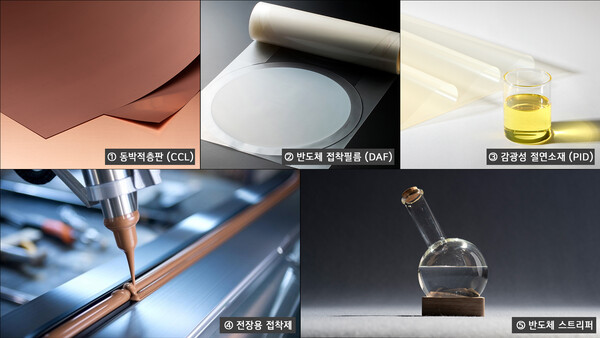
LG Chem aims to raise sales of electronic materials to 2 trillion won, double the current level. It plans to foster the segment as a core pillar of future growth to meet rising demand for high-performance electronic materials driven by AI semiconductors, autonomous driving and next-generation displays.
LG Chem said on Monday it will expand its 1 trillion won electronic materials business to 2 trillion won by 2030. Electronic materials are a field with high technological barriers to entry that helps secure long-term partnerships with customers. The company plans to integrate and establish an advanced R&D organization under its Advanced Materials Research Institute for semiconductors, automotive electronics and next-generation displays, and to speed up the shift in its future materials portfolio.
In semiconductors, it is expanding its packaging materials business to respond to rising demand for AI and high-performance computing (HPC). It is broadening its scope from memory materials technology to packaging materials for AI and non-memory chips. It has secured technological reliability in existing packaging materials such as CCL (copper clad laminate) and DAF (die attach film). It has recently completed development of PID (photo imageable dielectric) used for fine circuit interconnections and is working with global semiconductor companies. It is also pursuing preemptive development in next-generation packaging fields such as glass substrates.
In automotive materials, it is widening applications in line with growth in the electric vehicle and autonomous driving markets. It supplies solutions across various component areas including motors, power semiconductors, communications and sensors, as well as heat-dissipating adhesives for batteries and energy storage systems (ESS), and is also conducting joint development with automotive electronics companies. It is also continuing cooperation with global partners in future mobility materials, including SGF (switchable glazing film), which controls light and heat transmission in automotive glass, and photopolymer films for holographic windshield displays (HWD).
In display materials, demand for developing related materials is rising rapidly as applications expand to areas such as XR and robots. LG Chem plans to move to secure leadership in the next-generation display market based on its proprietary materials design technology and patent-based R&D capabilities.
Kim Dong-choon (김동춘), president and CEO leading the business strategy, joined the company in 1996 and has served as head of the semiconductor materials and electronic materials business division and as head of the advanced materials division. Since taking office, he has focused capabilities on high value-added businesses with high technological barriers and strong profitability. LG Chem said it was selected as the top global chemical and materials company in the 2026 "Top 100 Global Innovators."
Kim said, "LG Chem has continued to challenge itself and make leaps forward amid changes in the business environment by shifting its business portfolio from petrochemicals to advanced materials faster than anyone." He said, "Based on intense focus on future new materials, we will put all capabilities and technologies into becoming a technology-driven, high value-added advanced materials company."
 Daegeon Seok
d2dg@d-today.co.kr
Daegeon Seok
d2dg@d-today.co.kr