
Signs are emerging that South Korea's economic growth bar will be repeatedly lowered.
Rising international oil prices and damage to the real economy from Middle East risks are a path that appears set. But the course of events is so uncertain that it is not realistically easy to gauge the scale of the shock. This is also why it is hard for think tanks at home and abroad to hastily adjust growth forecasts.
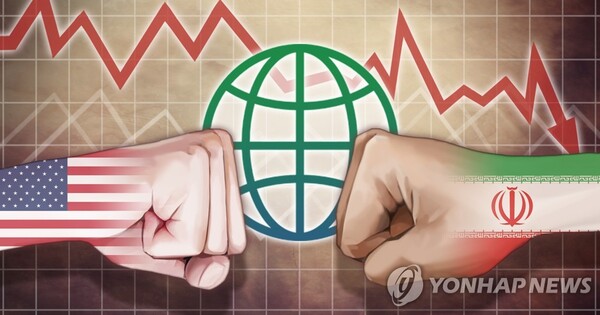
As of March 29, an extremely uncertain situation continues. The United States and Iran are reported to be weighing a ceasefire plan while also preparing for a ground war. That can be read as an attempt to boost bargaining power, but depending on how things unfold, it is hard to rule out the possibility of slipping into a protracted conflict.
Against this backdrop, the Organisation for Economic Co-operation and Development (OECD), a major international body, fired the opening signal for a reset in expectations by sharply lowering its growth forecast for South Korea this year by 0.4 percentage point to 1.7 percent from 2.1 percent.
The OECD kept its global growth forecast at 2.9 percent, but sharply lowered the growth outlook for South Korea and the euro zone (to 0.8 percent from 1.2 percent).
That is seen as reflecting a view that South Korea is structurally more vulnerable because it has high external dependence and a high share of Middle Eastern oil in its crude supply.
The OECD raised its growth forecast for the United States, which triggered the Middle East situation, by 0.3 percentage point to 2.0 percent from 1.7 percent, reflecting factors including an "artificial intelligence (AI) effect". It kept its forecasts unchanged for Japan (0.9 percent) and China (4.4 percent).
The uncertainty itself, with no clear sense of how far the Middle East situation will be contained, is likely to have a negative impact on growth.
Ultimately, there is a view that other research institutions will also adjust their forecasts one after another, starting with the OECD.
Citi lowered its growth forecast for South Korea by 0.2 percentage point to 2.2 percent from 2.4 percent, and Barclays revised it down to 2.0 percent from 2.1 percent.
Another analysis, from Woori Financial Management Research Institute, says if international oil prices stay above $100 a barrel as they are now, South Korea's annual economic growth rate could fall by more than 0.5 percentage point.
Kim Kwang-seok (김광석), head of economic research at the Korea Economic and Industrial Research Institute, said the OECD appeared to have made a fairly strong adjustment. He said the inflation adjustment was large, meaning South Korea has a structure that is heavily affected directly by an energy shock among OECD member countries.
The OECD raised its inflation forecast for South Korea this year by 0.9 percentage point to 2.7 percent from 1.8 percent.
Concerns are also emerging that beyond the channel in which inflation pushes up interest rates and cools the economy, an energy shock originating in the Middle East could hit supply chains across the real economy, from petrochemicals to semiconductors.
That is because there are not a few items in South Korea's supply chain with high dependence on Middle Eastern countries. Disruptions also appear unavoidable across key industrial supply chains, including petrochemical naphtha and helium and bromine used in semiconductor processes.
Although the government is pursuing a supplementary budget plan of around 25 trillion won, there is an assessment that it is not enough to offset all of the shock from the Middle East.
Depending on how the Middle East situation unfolds, achieving the 2.0 percent growth target this year will become difficult.
Kim Sang-bong (김상봉), a professor of economics at Hansung University, said, "If the war drags on, it is a situation we cannot help." He said, "In the short term it will affect prices, and in the long term it will inevitably affect consumption and growth."
[Yonhap News Agency]
 Online Team
d-today@d-today.co.kr
Online Team
d-today@d-today.co.kr