
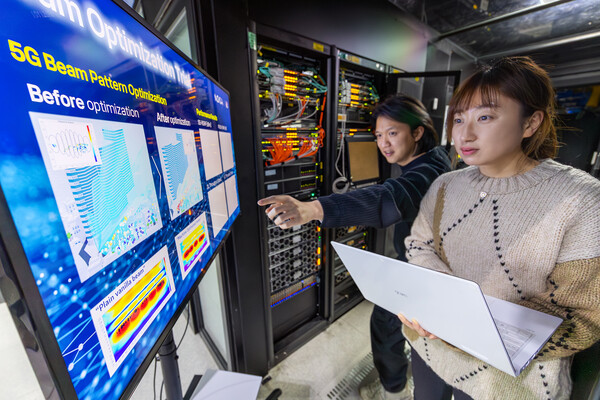
KT said on Sunday it has successfully verified an AI-based beam pattern optimisation technology with Nokia.
The verified beam pattern optimisation technology works by having AI analyse various network data, including traffic flows, in real time and actively reconstruct beam patterns. Beam patterns are a signal distribution that determines in which direction, with what width and strength, a base station antenna delivers beams, or signals.
Multiple-input multiple-output (mMIMO)-based 5G base stations widely used on commercial networks use multiple transmitting and receiving antennas to deliver different beams to many users at the same time. This can greatly increase communications capacity and efficiency, but choosing the best option is not easy because tens of thousands of beam pattern combinations are possible within a single cell, KT explained.
The technology uses an AI reinforcement learning-based policy improvement algorithm to efficiently search this vast pool of candidate beam pattern combinations and select only the best results. Through periodic learning, it adjusts beam strategies on its own to match environmental changes such as time of day or events. It confirmed that even in the same equipment environment it can provide higher wireless signal quality, more stable coverage and improved capacity processing performance.
The verification was conducted in February through cooperation between KT and Nokia's global research organisation to confirm the technology's effectiveness and stability. KT and Nokia plan to pursue field verification on a commercial network in the second half.
Jong-sik Lee (이종식), head of KT's Future Network Research Institute and an executive director, said, "Through cooperation with Nokia, we will further advance AI-RAN technology and expand commercial application."
 Jin-ho Lee
jhlee26@d-today.co.kr
Jin-ho Lee
jhlee26@d-today.co.kr